|
|||||||||||
 |
|||||||||||
 |
|||||||||||
|
|
|||||||||||
|
|
|
|||||||||||
|
|
|||||||||||
|
|
|||||||||||
|
|
|||||||||||
|
|
OTHER STYLES VCDs |
| Su Wenbin, Lü Zhenzhong: "Gong Li Quan - Power and Strength Boxing" set of VCDs: | ||
|
Item GLQ1-8 |
Gong Li Quan is a famous martial art that orginated and
has been practiced in Cangzhou in Hebei Province, the area with long
martial arts tradition. The style emphasizes both internal and external
development - hence its name : Gong - which here means Internal Power, and
Li - Physical Strength. The practice of the style focuses on developing
specific power which is a combination of both internal and external
strength. Gong Li Boxing does not contain any flowery movements, all its
techniques are practical and and have either defensive or attacking
applications. They combine hardness and softness with natural movements of
the body and light footwork. The methods of the system are not only
combat-oriented, but also include health preserving component (Li Fuchen,
one of Gong Li Boxing masters died at the age of 109). In practice the
breath should be coordinated with movements and "urge" the power so
that it could reach hands and feet and allow for swift responses - defense
or attack - to opponent's action. All movements in this set are clearly
explained in a easy to follow manner and shown from different angles. The
set is demonstrated by experts of Power and Strength Boxing from Cangzhou:
Su Wenbin, president of China Original Gong Li Boxing Research
Association, and Lü Zhenzhong, the vice-president of the Association: Note: Entire set (8 discs/8 boxes) is sold for discounted price of USD65.00 (costs of Handling and Shipping by Airmail INCLUDED). |
|
|
| Yan Xuefeng: "Buddha Fist" set of VCDs: | ||
|
Items BF1-5 |
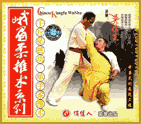
The style, also called "Fo Han Boxing", has its origins in the Shaolin Temple in Songshan Mountains. Buddha Fist Boxing was created over the years by many generations of "warrior-monks" and secretly preserved within their circles; it began to be taught to outsiders in 18th century after Shaolin temple was burnt in 1735 and monk Guangming escaped to Shandong and taught the system there. Unlike most Shaolin styles known nowadays its practice methods are mainly based on matched exercises with partner. In this way the style managed to preserved many essential fighting methods and applications that were lost in other Shaolin systems. The style use three strikes with each posture, each strike has three ways to block/intercept, and each of them can be accompanied by a counter-attack. This allows the practitioner to develop a wide set of various defense and attacking techniques. The set is demonstrated by Yan Xuefeng, the president of China Fo Han Boxing Research Association and 6th generation inheritor of the style: 1."Traditional Twelve Postures (includes
Routines Demonstrations of Fo Han Boxing)" (Chuantong Shi Er Shi Ji
Xinshang), (1 disc/1 box), USD8.50 (Sh&H not included) Note: Entire set (16 discs/10 boxes) is sold for discounted price of USD108.00 (costs of Handling and Shipping by Airmail INCLUDED). |
|
|
| Duan Qilin: "Unique Self-defence Methods" set of VCDs: | ||
|
Items SDM1-10 |
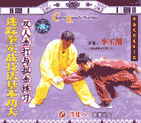
The set presents over one hundred self-defense methods
against barehand as well as knife attacks. Each method is shown from two
angles in normal speed, then shown slowly and explained in a step-by-step
manner with stress on correct timing, use of force, counter-attack
techniques and angles. These methods are based on the chosen techniques of
traditional Chinese martial arts, and are taught to soldiers of Chinese
army (PLA), and can be used for individual self-defense. The set is
demonstrated by Duan Qilin, China 1st Grade Coach, expert of Emei Boxing,
teacher of free fighting as well as martial arts coach for Chinese army: |
|
|
| Su Long: "Shaolin Praying Mantis (Tanglang) Boxing" set of VCDs: | ||
|
Items SPM1-17 |
Shaolin Praying Mantis Boxing is a branch of Tanglangquan less known than popular Seven Star, Plum Blossom or Six Harmonies branches. Sun Haiming, Tanglang Boxing expert from Shandong, taught Seven Star and Plum Blossom styles in Anhui Province; these styles were later combined with local Shaolin Boxing style into a system of Shaolin Tanglang Boxing. The style belongs to "hard Praying Mantis" category - its movements are fast, powerful, techniques linked and used in combinations. While the style also uses the basic Hooking (Gou), Pulling (Lou), Plucking (Cai) and Hanging (Gua) methods that are common for all Praying Mantis branches, it also combines many Shaolin Boxing hand and kicking methods, and emphasizes elbow strikes, which makes it very effective in close range fighting. Demonstrated by Su Long, expert of Shaolin Tanglang Boxing from Anhui Province:
1."Basics" (Ji Ben Gong, basic strikes, kicks, etc. of the system) Note: Entire set (17 discs/17 boxes) is sold for discounted price of USD138.00 (costs of Handling and Shipping by Airmail INCLUDED). |
|
|
| Yang Xiaojun: "Chuojiao Fanzi Boxing from North-eastern China" set of VCDs: | ||
|
Items CFB1-9 |
Chuojiao Fanzi Boxing is a famous martial art popular in northern China. It is a merge of two styles: Chuojiao (Poking Kicks) and Fanzi (Overturning Boxing). Chuojiao is well known for its kicking techniques and considered a representative of famous "northern legs"; curriculum of Chuojiao Boxing is divided into Scholar's Routines (Wen Tangzi) with compact movements, low kicks and stress on neutralizing power, and Martial Routines (Wu Tangzi) with bigger, more open movements, high kicks and hard power. Fanzi Boxing is known for its numerous hand techniques and stress on changes. Both styles are often practiced together for developing more complete fighting skills. There are three main branches of the style - Hebei, Beijing and North-eastern, which is presented on this set. It is popular in Shenyang and was popularized there by late master Hu Fengsan, one of three most famous martial arts expert in North-eastern China. The set is demonstrated by Yang Xiaojun, famous expert of the style: 1."Crisp Eight Overturns Fanzi Boxing" (Cui
Ba Fanzi Quan, stresses attacking three levels on opponent's body with
series of strikes), (2 discs/1 box), USD13.50 (Sh&H not included) |
|
|
| Huang Jingou: "Hard Gate Boxing - Ying Men Quan" set of VCDs: | ||
|
Items YMQ1-8 |
Hard Gate Boxing (Ying Men Quan)
is a rare martial art practiced only in Jiangxi Province. In its original
form it was called Yi He Quan - the style originally practiced by the
members of Yi He Tuan, secret society which participated in Boxers
Rebellion in 1899. During Qing Dynasty the style was transmitted to
Jiangxi from Guangdong Province and became one of the three most famous
styles there. It is an external style which stresses hardness, speed and
power. Its routines are short, easy to learn with clear fighting
applications. The set is demonstrated by Huang Jingou, 4th generation
inheritor and expert of Ying Men Quan: Price: USD8.50 for each item (Sh&H not included); all items are one disc/one box. Note: Entire set (5 discs/5 boxes) is sold for discounted price of USD68.00 (costs of Handling and Shipping by Airmail INCLUDED). |
|
|
| Liu Yi: "Ancient Shaolin Boxing" set of VCDs: | ||
|
Items ASB1-9
|
The ancient Shaolin Boxing was taught by monk Fuju of Song Dynasty and has been transmitted to our times. Because the name Shaolin Boxing has been later used by many various martial arts, the art of Fuju has later been referred to as Shaolin Xing'gong Boxing - in which practice methods are merged with fighting techniques. Yang Xiushan (1885-1949), one of its famous masters nicknamed "Iron Palm Shakes Eastern Sea" taught the style to Gao Zhuojun (1917-2003). Ancient Shaolin Boxing is practiced only in very few areas in southern parts of Henan Province and is close to extinction. The core of the system are ten bare hand routines. It stresses explosive power, speed, agile footwork, has rich arsenal of both hand and kicking techniques. This set of VCDs is demonstrated by Liu Yi, 32nd generation inheritor of the style as well as main combat instructor for special forces of Chinese People's Liberation Army: 1."First Routine - Nine Strengths and
Eighteen Methods" (Yi Lu - Jiu Li Shi Ba Gong, basic routine of the
system with focus on power and speed), (1 disc/1 box), USD8.50 (Sh&H
not included) Note: Entire set (11 discs/9 boxes) is sold for discounted price of USD88.00 (costs of Handling and Shipping by Airmail INCLUDED). |
|
|
| Wang Feng: "Cha Quan of Li Family" set of VCDs: | ||
|
Items LCQ1-15 |
Cha Quan is a famous martial art popular among Chinese Moslems, known for its long distance techniques, multiple striking, throwing and seizing fighting methods, with a special focus on kicking. Its "Ten Character Formula" says "Contract, Be Small, Continuous, Soft, Agile, Subdue, Fast, Hard, Crisp, Cunning". The basics of the system are either Ten Sets of Elastic Kicks or Ten Sets of Pounding Strikes, while the practice and fighting methods are collected into ten routines. The style is most popular in Shandong province and over centuries evolved into three main branches - Zhang Family and Yang Family Cha Quan from Guan County as well as Li Family Cha Quan from Rencheng. The Li Family branch was created by Cha Quan master Li Enju, and since Li was a very conservative teacher it is also the most rare; at the same time it is also considered to be the closest to the original Cha Quan system. This set not only contains instructions how to practice the movements, but also many fighting applications and their possible changes. The set is demonstrated by Wang Feng, expert and 4th generation inheritor of Li Family (Rencheng) Cha Quan: 1."Ten Routines of Pounding Strikes" (Shi
Lu Dao Chui, ten short sets that can be practiced on both sides;
contain all basic techniques of the system; similar to Tan Tui - Elastic
Kicks), (1 disc/1 box), USD8.50 (Sh&H not included) Note: Entire set (16 discs/15 boxes) is sold for discounted price of USD128.00 (costs of Handling and Shipping by Airmail INCLUDED). |
|
|
| Liu Yanfeng: "Fa Men Quan - Method Gate Boxing from South Shaolin" set of VCDs: | ||
|
Items FMB1-7
|
Method Gate Boxing (Fa Men Quan) is a rare martial art practiced only in Jiangxi Province, one of three local styles there along with Zi Men and Ying Men Boxing. Its origins are not clear but it is believed that the style comes from southern Shaolin Temple in Fujian Province. The style has a very systematic approach to teaching, starting from basic methods that develop root (Horse Riding stance), agile footwork, power, striking/kicking ability, hardness, etc., to various empty hand and weapons routines and then to fighting practice. The routines are divided into two categories - "Galloping Horse" with stress on fighting skills, and "Still Standing" with focus on root, leg strength and whole body power. The style emphasizes natural movements, uses relaxed, fast movements with hardness hidden in softness. It applies agile footwork to approach the opponent from unexpected angles, strikes in close range, does not use brute force. The set is demonstrated by Liu Yanfeng, expert of Fa Men Quan from Zhangshu City in Jiangxi Province: 1."Basic Methods" (Ji Ben Gong;
"Ten Small Exercises" are main part of basic training of Fa Men Boxing,
which focus on basic hand, body techniques, footwork as well as develop
methods of "Swallowing and Spitting" and "Sinking and Floating"), (2 discs/1
box), USD13.50 (Sh&H not included) Note: Entire set (8 discs/7 boxes) is sold for discounted price of USD65.00 (costs of Handling and Shipping by Airmail INCLUDED). |
|
|
| Liu Yi: "Combat Methods of Chinese Special Forces" set of VCDs: | ||
|
Items CSF1-14
|
People's Liberation Army (PLA) of China has its own system of combat methods that is taught to its special forces. The system is based on techniques from traditional Chinese martial arts that were modified to better suit the needs of army training and to achieve high combat effectiveness in the shortest possible time spent on training. Its main methods cover hand to hand combat techniques (striking, kicking, throwing, seizing) as well as defense against an armed opponent (with knife, gun). It also includes training of special skills like wall climbing or fighting in any - also very difficult - environment. The set is demonstrated by Liu Yi, coach of combat for special forces as well as expert of traditional Shaolin Boxing: 1."Basics of Combat" (Boji Ji Ben
Gong), (1 disc/1 box), USD8.50 (Sh&H not included) Note: Entire set (16 discs/14 boxes) is sold for discounted price of USD128.00 (costs of Handling and Shipping by Airmail INCLUDED). Also available on DVD (with English subtitles) - click for details |
|
|
| Hu Chunguang: "Shun Shi Quan - Smooth Postures Boxing" set of VCDs: | ||
|
Items SSQ1-16
|
Smooth Postures Boxing (Shun Shi Quan) is a rare martial art which was created over one hundred years ago by Feng Wanhe, famous bodyguard from Hebei Province. Its core feature is stressing "smoothness" - smoothness of postures, Qi (internal energy), power. Postures are fundaments for power releasing, Qi is the source of power release, while power is issued from waist and hips and based on the leg strength. The style shows similarity to long fist boxing and uses variety of high kicks, long distance strikes, but at the same time emphasizes softness, using waist and whole body for striking, and share principles with internal styles, It combines slow and fast movements, hardness and softness, power releases with smooth and continuous movements. The set is demonstrated by Hu Chunguang, expert of the style and its 5th generation inheritor. Hu Chunguang studied the style from early childhood from his grandfather and shows very impressive skill for a person who is over 50 years old: 1."Basic Method - Ten Kicking Sets" (Shi
Tang Tui; basic set of ten short sequences focusing on kicking and
stressing body and hand movements, internally developing Qi and externally
developing strength), (1 disc/1 box), USD8.50 (Sh&H not included) Note: Entire set (17 discs/16 boxes) is sold for discounted price of USD138.00 (costs of Handling and Shipping by Airmail INCLUDED). |
|
|
| Various Performers: "Demonstrations of a Hundred Masters" set of VCDs: | ||
|
Item DHM
|
In June 2004 in Beijing Guangzhou Beauty
Company (main producer of video materials on Chinese Martial Arts) held a
conference which gathered over a hundred of traditional martial arts
experts from China. The goal of the meeting was to discuss the
perspectives of development for traditional Chinese martial arts,
promoting the arts abroad and exchane the skills. The discs contain
demonstrations of the expert who participated in the conference, including
Di Guoyong (Xingyiquan), Shi Dejun (Shaolin Boxing), Chen Zhenglei (Chen
Style TJQ), You Xuande (Wudang Boxing) as well as many other representing
various branches of Taijiquan, Baguazhang, Tumble Boxing (Di Tang Quan),
Lost Track Boxing (Mi Zong Quan), Yi Quan, etc. NOTE: This set contains only demonstrational material, not instructional. |
|
|
| Liu Zhenhai and others: "Traditional Martial Arts of Shaolin - Part Two" set of VCDs: | ||
|
Items LZH[2]1-49
|
This is the second part of popular Shaolin set covering material taught by Liu Zhenhai, one of Ten Best Teachers of Shaolin Boxing. Liu Zhenhai learnt Shaolin Boxing from Degen, one of the last ld generation warrior monks from the temple. The material presented in this set is not flowery modern "Wushu dancing", but old Shaolin Boxing system. It is said that Liu Zhenhai - unlike many other teachers of Shaolin martial arts - has kept the material he learnt from Degen unchanged and hence the routines presented in this set are orthodox sets taught in Shaolin temple in early 20th century. They are demonstrated by Shaolin Temple warrior monks; apart from instructions on the choreography of the routine many of the discs also cover their fighting applications: Routines demonstrated by Shi Yanci (Shaolin
warrior monk): Price: USD8.00 for each item (Sh&H not included); all items are one disc/one box. Note: For purchases of 15 items and more FREE Handling and Airmail Shipping; Special Offer: Entire set (49 discs/49 boxes) is sold for discounted price of USD358.00 (costs of Handling and Shipping by Airmail INCLUDED). |
|
|
| Ma Lei: "Traditional Chinese Seizing (Qin'na) Methods" set of VCDs: | ||
|
Items TQN1&2
|
Seizing/Capturing (Qin'na/Chin Na)
methods are important part of any Chinese martial art as well as
independent skills traditionally referred to as "Seventy Two Seizes". These
methods are usually used in defensive against unarmed or armed opponent. Qin'na not only
can be an effective method of self-defense, but also used
as devastating counter-attack. It contains seizing, grabbing, joint
locking, joint breaking, and can also be combined
with striking/kicking techniques to form more complex self-defense
sequences. This set presents 35 various Qin'na methods, including barehand
seizing as well as defense against attacker with knife. The method is
first demonstrated in full speed, then shown in slow speed broken into
several parts. All techniques are demonstrated by Ma Lei, highly respected
Qin'na
expert in police circles in China, one of first Chinese teachers of combat
for police forces who was allowed to teach outside of the country. Ma Lei
was also combat teacher for imperial guards in Ghana. NOTE: Narrated both in Chinese and ENGLISH. |
|
|
| Gao Xiang: "Fighting Methods of Traditional Chinese Martial Arts" set of VCDs: | ||
|
Items TFM1-6
|
The set introduces fighting methods of traditional Chinese martial arts, that can be divided into two categories: general skills (throwing, grappling) and specific methods belonging to certain traditional styles. The former ones can be learnt and applied by practitioners of any martial art to further develop certain skills, while the latter are based on specific techniques/strategies/application of such styles like Tiger Boxing or Arhat (Luohan) Boxing. All techniques demonstrated by Gao Xiang, expert of traditional Chinese martial arts, and his student Yin Guojie: 1."Iron Claws Seizing (Qin'na/Chin
Na) Techniques" (Tie Zhua Qin'na Shu, contains seizing techniques
that can be applied to various parts of opponent's body: neck, shoulder,
elbow, wrist/fingers, waist/hips, knees, ankle as well as reverse seizing
(anti-qin'na) techniques) Price: USD8.50 for each item (Sh&H not included); all items are one disc/one box. NOTE: Entire set (6 discs/6 boxes) is sold for discounted price of USD55.00 (costs of Handling and Shipping by Airmail INCLUDED. |
|
|
| Zhang Feihu, Zhang Feipeng: "Arresting and Anti-rioting Techniques of Chinese Police Forces" set of VCDs: | ||
|
Items AAR1-5
|
First video material ever to present various techniques used by Chinese police against suspected criminals. The set defines the difference between the methods used by the military and police when capturing the enemy/criminal, takes into consideration restriction imposed by the law, analyses the techniques from the point of view of human anatomy and movement mechanics. The methods are demonstrated from different angles, clearly explained in easy-to follow, step-by-step manner, important are points stressed. The methods introduced on the set are easy to learn and master, and can be studied not only by police or security forces, but also any person interested in efficient self-defense techniques. The techniques are explained and demonstrated by Zhang Feihu, teacher at the Gansu Province Police Academy, who many times successfully took part in national boxing and Sanda competitions, member of Gansu Province Boxing Association, secretary of Lanzhou Martial Arts Association, editor of Gansu Police Professional Academy Magazine; Zhang Feipeng, 4 times winner of All-China Martial Arts Competitions, has been teaching free fighting and self-defense skills for over 20 years, vice-president of Lanzhou Martial Arts Association. Both Zhang Feihu and Zhang Feipeng are professional members of Chinese police forces: 1."Thirty Six Methods of
Defeating the Enemy by Surprise" (Chu Qi Zhi Sheng San Shi Liu Zhao,
36 methods to take the opponent by surprise and strike/seize him
unexpectedly; stress both speed/strength/accuracy and plan in defeating
the opponent; the guiding principle of these methods is "take the opponent
by surprise, seize him unexpectedly"; use both grabbing and striking), (2
discs/1 box), USD13.50 (Sh&H not included) |
|
|
| Various Performers: "The Second Zhejiang International Traditional Wushu Tournament (2004)" set of VCDs: | ||
|
Item ZWT
|
The Competition was held in Hangzhou,
Zhejiang Province in August 2004. There were over 2000 Chinese
participants from 9 provinces as well as foreign teams. They demonstrated
over 4000 various routines, mainly from southern China. The first disc
starts with opening ceremony and continues with many demonstrations of
empty hand routines, while the second disc contains demonstrations of
various weapons routines like staff, spear, sword, broadsword, deer horn
knives, Monk's Spade, long pole and many other. NOTE: This set contains only demonstrational material, not instructional. |
|
|
| Various Performers: "The Best of Empty Hand and Weapon Two Man Sets of Chinese Martial Arts" set of VCDs: | ||
|
Item BTM
|
Very complete
overview of matched (two person) routines, popular training method in Chinese
martial arts. Traditionally the sets were designed to introduce the
practitioner to working with an opponent, teach fighting basics and
principles, develop timing, distance, sticking skills and "feeling"
opponent's movement/strengths. This set of VCDs contains many two-man sets
- both empty hand and with weapons - belonging to various styles. There
are sets from styles like Plum Blossom Poles (Mei Hua Zhuang), Baji,
Praying Mantis (Tanglang), Big Hong Boxing, Tai Zu Boxing, Buddha
Fist as well as other styles. Of internal styles one will find Bagua
Matched set demonstrated by Sha Junjie (Sha Guozheng's son) and his wife,
Bagua Chopping Broadswords (Dui Pi Dao), Xingyi Two Man sets with
Sticks, Straight Swords as well as empty hand; there is also a whole
variety of various weapon versus weapon sets with spears, three sectional
cudgels, broadswords, daggers, hammers and many others. Most of the sets
sets are performed by two practitioners, but there are also sets of two
against one and a "group fighting" routine. The sets present mainly
traditional sets, but there are also some modern Wushu demonstrations.
Many demonstrations come from historical footages taken in early 1980s and
are performed by old masters, many of whom have in the meantime passed
away. NOTE: This set contains only documentary/demonstrational material, not instructional. |
|
|
| Various Performers: "The Best of Traditional Chinese Weapons" set of VCDs: | ||
|
Item BTW
|
This is one of the most complete
overviews of various Chinese weapons. Often referred to as "Eighteen
Skills" (Shi Ba Ban Wuyi) they actually cover many more weapons and
rouitnes. This set contains demonstrations by many experts of traditional
Chinese martial arts who demonstrate their skills of using
not only classical weapons - Spear, Broadsword, Straight Sword, Stick -
but also many rare weapons as well as objects used in daily life:
Walking (Guai), Long Pipe (Lan Mian Sou), Fan (Shan),
Chain (Duo Jie Bian), Weight on a Rope (Liu Xing Chui),
Chopsticks (Kuaizi), Big Fork (Cha),
Wind and Fire Wheels (Feng Huo Lun),
Hooks (Gou), Hammers (Chui), Emei Needles (Emei Ci),
Willow Leaf Broadsword (Miao Dao) and many more.
Rare historical demonstrations by many famous
old experts as well as
younger practitioners. Valuable to those
interested in traditional Chinese weapons as well as their practice
methods. NOTE: This set contains only documentary/demonstrational material, not instructional. |
|
|
| Various Performers: "The Best of Chinese Martial Arts - Demonstrations by 100 Outstanding Wushu Masters" set of VCDs: | ||
|
Item BCM
|
This set presents many experts of
Chinese martial arts, both traditional ones and modern Wushu. This
collection documents the campaign of choosing "One Hundred Outstanding
Wushu Masters" in modern Chinese Martial Arts. It took two years before
the group has been selected. The set records many of those masters - old
ones, like Zhang Wenguang (Cha Quan), Cai Longyun (Hua Quan), Xia Bohua (Xingyi
and Bagua), as well as younger ones, like Yuan Wenqing (famous modern
Wushu practitioner, who dominated modern Wushu in China after Jet Li and
Zhao Changjun), Gao Jiamin, Zhu Ruiqi and many others. You will find here
interviews with these experts, their demonstrations (including many old
documentaries), hear how they explain principles of their particular
styles. Interesting material to those who want to know more about who is
who in Chinese martial arts in modern China. NOTE: This set contains only documentary/demonstrational material, not instructional. |
|
|
| Various Performers: "Modern Wushu Superstars" set of VCDs: | ||
|
Item WSS
|
This set shows demonstrations of
contemporary Wushu by most famous athletes, starting from early
performances by young Li Lianjie (Jet Li) in 1970s, through "golden era"
of modern Wushu - "explosion" of Wushu superstars after the movie "Shaolin
Temple" was shown all over the world in early and mid-1980s, until late
1990. The discs include competition demonstrations by Li Lianjie (Fanzi
Boxing, Broadsword; main hero in the movie "Shaolin Temple"), Zhao
Changjun (Di Tang Boxing, Stick, Broadsword; Zhao Changjun became famous
after playing one of main characters in the movie "Wudang"), Ge Chunyan (Baguazhang,
Sword; played one of main roles in "Honor of Dongfang Xu"), Hu Jianqiang
(Monkey Boxing, Monkey Staff; Li Lianjie's partner in "Shaolin Temple"),
Xu Xiangdong (Eagle Claw Boxing; played in the movie "Shaolin Boddhidharma")
and many others world Wushu champions. Routines also include Drunken
Boxing, Praying Mantis Boxing, Southern Boxing, Xingyi, Taiji, Long Fist
Boxing and many others. NOTE: This set contains only documentary/demonstrational material, not instructional. |
|
|
| Liu Hailong and Others: "Liu Hailong - Great Sanda Fighter" VCD: | ||
|
Item LHL |
This set presents Liu Hailong - the most
famous and successful Sanda (Chinese fighting sport) fighter of the last
years. Liu Hailong became famous after his victory in all-China King of
Sanda Competition in 2000 when he was only 19. Later Liu Hailong has been
winning all major Sanda events in China and abroad, including World Sanda
Championships, Chinese Kungfu vs Muai Thai, Sino-American World Sanda
Competition and many others. Liu has been considered one of the most
talented Sanda fighters of the recent years and is fights a display of
highest level of Sanda. The disc contains several most important final
fights of Liu Hailong against both high level Chinese fighters and foreign
one (representatives of Sanda, Muai Thai, Kickboxing). Interesting to
Sanda and other fighting sports practitioners. NOTE: This set contains only demonstrational material, not instructional. |
|
|
| Various Performers: "Sanda Heroes" VCD: | ||
|
Item SDH |
This set contains a collection of best
Sanda fights from the last twenty years. They show best Chinese Sanda
fighters (like Liu Hailong, Bao Ligao, Chen Chao, Nashun Geriqin, Yuan
Yubao and many others) in their top form, fighting their most
representative fights. Good overview of what modern Sanda looks like at
its best and good material for analysis of its techniques, strategies,
methods. The set presents fights between Chinese fighters as well as
against foreign athletes from Egypt, Thailand, Brazil, Japan, USA and
Korea. NOTE: This set contains only demonstrational material, not instructional. |
|
|
| He Jungang: "Hua Quan Boxing" set of VCDs: | ||
|
Item HJG1-7 |
Hua Quan Boxing is one of four - along with Cha, Pao and Hong - famous Chinese martial arts from Northern China belonging to long fist category. Its name - often translated as "Chinese Fist" or "Hua Mountain Boxing" - in fact means "Essence Boxing" as it stresses the use of Vitality, Qi and Spirit - "three Essences" in all its movements. The style was created in Shandong Province and later spread all over China. It contains many routines with twelve sets of Hua Quan being the core of the system; each of them can be practiced by one person or as matched routine with partner. The style contains both long and close range methods, with focus on kicking (including high and jumping kicks), sweeping and striking. The movements are fast and powerful, postures firm. In the recent decades the style has been actively taught by Cai Longyun and Cai Hongxiang, Hua Quan experts from Shanghai. The material on this set is demonstrated by He Jungang, Hua Quan expert from Huaibei City in Anhui Province. 1."First Routine of Hua Quan" (Yi
Lu Hua Quan;
first set of twelve advanced routines of the system; contains all core
methods of the system - 5 hand shapes, 12 hand techniques, 5 stances, 7
footwork methods), (3 discs/2 boxes), USD18.50 (Sh&H not
included) Note: Entire set (11 discs/8 boxes) is sold for discounted price of USD80.00 (costs of Handling and Shipping by Airmail INCLUDED). |
|
|
| Xu Tianxiang, Chen Zhenhong: "Taiji Ancestor - Hongdong Tongbei Quan" VCD: | ||
|
Item HTQ1-11 |
Hongdong Tongbei Quan - also known as Wuji Tongbei Coiling Boxing - is a rare martial art practiced mainly in Hongdong County in Shanxi province. One of the theories of its origins links the style to Guo Yongfu from Henan, probably a member Chen family from Chenjiagou famous for their Chen Style Taijiquan. "General Theory of Boxing Classic" is a text that is shared by both Hongdong Tongbei Boxing and Long Fist Boxing of Chen family. Hongdong Tongbei Boxing combines features of both internal and external styles. Its principles require the practitioner to release power from the back; the movements should be big, neither too stiff nor too soft; it is also called "Coiling Boxing" because of using coiling as core fighting method; the other meaning of coiling is to coil around the opponent with constantly changing attacks until the opponent is defeated; the power should be "cold, fast, crispy, hard, continuous, elastic"; the hardness should be coupled with softness - hard as steel, soft as cotton, using hardness to strike opponent's weak areas and softness to neutralize his hardness; special attention is given to ability to change, responding swiftly to opponent's changes, sharp reflexes and right timing. Hongdong Tongbei system includes Mother Boxing (Mu Quan i.e. famous Long Fist Boxing in 108 Postures of Chen Family), Sons Boxing (Zi Quan), weapons and two persons routines. The system also contain a large number of supplementary methods developing physical strength, hardness of feet and hands, flexibility. Demonstrated by Xu Tianxiang, 9th generation inheritor of the style and vice-president of Hongdong Tongbei Boxing Research Association. Interesting material not only to those who want to learn the Hongdong Tongbei system, but also to Chen Style Taijiquan practitioners. 1."Hongdong Tongbei Coiling
Boxing in 108 Postures" (Hongdong Tongbei Chan Quan Yi
Bai Ling Ba Shi;
the core routine of the system and "sister" routine to Chen Style Taiji
Long Fist Boxing; contains wide variety of fighting techniques, including
8 Cannons, 36 Throws, 36 Elbows, 36 Kicks, 72 Throws, 108 Close Range
Fists, etc.), (4 discs/2 boxes), USD21.50 (Sh&H not
included) Note: Entire set (16 discs/12 boxes) is sold for discounted price of USD115.00 (costs of Handling and Shipping by Airmail INCLUDED). |
|
|
| Li Junde: "Qing Ping Sword" set of VCDs: | ||
|
Items QP1-6 |
Straight Sword has always been one of the most respected weapons China, often associated with power and high social status, carried by generals, high rank officials and scholars. Sword is often referred to as "the master of one hundred weapons" and is considered one of the most difficult weapons to learn and use effectively. Qing Ping sword is one of the oldest known classical sword styles. Its name appears in texts from Han and Tang dynasties, including poems by Li Bai. Legend recorded in old sword manuals traces its origins to Tiger and Dragon Mountains (Long Hu Shan) in Jiangxi Province, one of craddles of Taoism in China, where it was created by a Taoist Pan Yuangui. Pan taught it to Men Jiaohua from Shandong, who in turn passed it to Feng Xitang. Feng in turn taught it to Yang Elin, who was the first layman - not a Taoist priest - to learn Qing Ping Sword method. Later one the sword was taught mainly among Six Harmonies and Lost Track Boxing practitioners in Hebei Province. Qing Ping Sword is divided into six routines and contains 175 recorded postures - although in fact there are often 2 or 3 postures under one name. The sets are studied from the simplest First Routine to most complex Sixth Routine. It contains 16 basic sword methods which focus on using superior technique instead of strength to defeat the opponent; the practice of Qing Ping Sword develops coordination of hands, eyes, body and footwork; the postures vary from high to very low and stress the strength of legs and waist; the footwork is agile, waist must turn at will, wrist be flexible. This set of VCDs is demonstrated by Li Junde from Cangzhou in Hebei Province (one of the most famous for martial arts places in China), member of Cangzhou Practical Fighting Association, Cangzhou Muslim Martial Arts School, inheritor of the orthodox Six Harmonies Boxing and Qing Ping Sword. Li Junde comes from a family with long MA practice tradition - his grandfather Li Shuting (Da Qiang Li Wuye - "Big Spear Fifth Grandpa Li") was famous for his skills in Six Combinations Long Spear and Qing Ping Sword and taught many disciples, including famous Wang Ziping: 1."First Routine of Qing
Ping Sword" (Qing Ping Jian Yi Lu) All items are one disc/one box. Note: Entire set (6 discs/6 boxes) is sold for USD50.00 (costs of Handling and Shipping by Airmail INCLUDED). |
|
|
| Li Junde: "Six Harmonies Boxing" set of VCDs: | ||
|
Items SHB1-17 |
Six Harmonies Boxing is one of the oldest Chinese martial arts that have been transmitted until today. It was mentioned in General Qi Jiguang's famous treatise on martial arts in 16th century. It has produced many renowned martial artists like Wang Ziping or Tong Zhongyi. The style is named after Six Harmonies of the body: harmony between eyes and mind, gut and strength, Qi and blood, body and hands, hands and feet, feet and hips; however some of this branches relate the name to six directions or names of six creators of the system. It is characterized by strong techniques, focus on hard power, big movements tightly linked together; clear combat methods based on sudden changes; in fighting the practitioner of Six Harmonies Boxing after a strike uses a seizing technique which is then followed by a throw. In all of its practice methods the system emphasizes Six Harmonies - coordination of legs, waist and shoulders - as well as controlled breathing. The set is the most complete instructional video material presenting Liu He Boxing. Demonstrated by Li Junde from Cangzhou in Hebei Province (one of the most famous for martial arts places in China), member of Cangzhou Practical Fighting Association, Cangzhou Muslim Martial Arts School, inheritor of the orthodox Six Harmonies Boxing and Qing Ping Sword. Li Junde comes from a family with long MA practice tradition - his grandfather Li Shuting (Da Qiang Li Wuye - "Big Spear Fifth Grandpa Li") was famous for his skills in Six Combinations Long Spear and Qing Ping Sword and taught many disciples, including Wang Ziping: 1."First Routine of Six
Harmonies Boxing" (Liu He Quan Yi Lu, elementary routine,
focuses on encircling, redirecting and entrapping, uses attack for defense
and defense to attack) Price: USD8.50 for each item (Sh&H not included); all items are one disc/one box. Note: Entire set (17 discs/17 boxes) is sold for discounted price of USD138.00 (costs of Handling and Shipping by Airmail INCLUDED). |
|
|
| Shi Dejun: "Shaolin Martial Arts" set of VCDs: | ||
|
Items SDJ1-27 |
Another set on traditional Shaolin Martial Arts
presenting many classical and less known routines of the school. Released
by Shi Dejun, the 31st generation "warrior monk" (Wu Seng) from
Shaolin Temple, one of "Ten Best Martial Arts Teachers" in China. Since
1983 Shi Dejun began Shaolin boxing practice under Su Fa, old monk from
Shaolin temple; later on he became last disciple of renowned warrior-monk
Master Su Xi; Shi Dejun also learnt Praying Mantis Boxing from famous Li
Zhaoyuan of Shandong. He has also been teaching Shaolin martial arts to
special units of Chinese police forces: 1.Shaolin Long Fist Boxing (Shaolin Chang Quan,
Long Fist Boxing in 32 postures, created by Zhao Kuangyin, first emperor
of Song dynasty) Price: USD9.00 for each item (Sh&H not included); all items are one discs/one box. Special Offer: Entire set (26 discs/26 boxes) is sold for discounted price of USD230.00 (costs of Handling and Shipping by Airmail INCLUDED). |
|
|
| Various Performers: "Red Fist Boxing" set of VCDs: | ||
|
Items HQ1-13 |
Red Fist Boxing (Hong Quan) is a traditional martial art practiced in the countryside of Shaanxi Province. With its roots in Shaolin Temple it is characterized by strong, fast, whip-like hand techniques, agile footwork, large postures, and a wide variety of kicks. Red Fist Boxing emphasizes round movements, power is soft on the outside and hard inside, steps are light. Its combat strategy stresses "clever" fighting, defeating the opponent with footwork, entering and striking with the body. Demonstrations and step-by-step instructions by experts of traditional Hong Quan from Shaanxi Province Local Martial Arts Research Association:
1."Knight Boxing" routine (Xia Quan); demonstrated by Shao Zhiyong Note: Entire set (13 discs/13 boxes) is sold for discounted price of USD118.00 (costs of Handling and Shipping by Airmail INCLUDED). |
|
|
| Wu Xinliang: "Emei Martial Arts" set of VCDs: | ||
|
Items EM1-17
|
Emei Martial Arts come from Emei Mountain in Sichuan Province and are consider one of three - along with Wudang and Shaolin - famous schools of Chinese Martial Arts. Emei styles have been strongly influenced by martial arts practiced in China's Central Plains, as well as Buddhism and Taoism. Emei styles combine both hardness Shaolin styles are known for, with internal breathing methods characteristic to Wudang. Emei Martial Arts are divided into eight main branches with Yue, Hua and Zhao being the most famous. Wu Xinliang, the most famous expert of Emei Martial Arts, has not only learnt from many renowned masters, but served as the first coach of Sichuan Sanda team. Wu is also the creator of Emei Soft Pushing Method: 1.Basics of Emei Boxing (Emei Pan Gong,
exercises improving balance and flexibility); Price: USD9.00 for each item (Sh&H not included); all items are one disc/one box. Note: Entire set (17 discs/17 boxes) is sold for discounted price of USD148.00 (costs of Handling and Shipping by Airmail INCLUDED). |
|
|
| Xia Liwen: "Practical Sanda" set of VCDs: | ||
|
Item XLW1&2 |
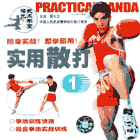
Sanda has already become a recognized
sport combining various fighting techniques of traditional Chinese martial arts.
Gaining growing popularity both in China and abroad, it is known for using
a variety of fighting methods, including not only punching and kicking,
but also throwing. This set, presented by Xia Liwen, Sanda coach of
Chinese People's Armed Police Units, is divided into two parts. The first
one explains basic fist techniques, their combinations and practical
applications in attack and defense; the second part focuses on kicking
techniques - basic drills, practice methods, combinations and practical
applications. |
|
|
| Yin Shuzeng: "Cannon Boxing of Three Emperors" set of VCDs: | ||
|
Items YSZ1-6
|
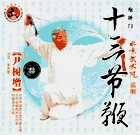
Cannon Boxing of Three Emperors is one of the most respected martial arts in China, known for its no-nonsense attitude towards practice and strong focus on methods effective in real combat. It is one of four famous Chinese martial arts (along with Cha, Hua and Hong Boxing). It was the obligatory style for all members of Huiyou Caravan Escort Bureau, the most famous such organization in Northern China. in 1930s and 40s its members took active part in battles against Japanese invaders. The style is famous for its explosive use of power, combining softness with hardness, firm stances and agile footwork. Yin Shuzeng who explains the movements in this set, is one of the main experts of the style in China, and a disciple of late Li Yaochen (famous for creating a set of broadsword methods for Chinese guerilla troops fighting Japanese army in 1930s): 1."First Routine of Li Yaochen's Cannon
Boxing of Three Emperors - Heavenly Emperor" (Li Yaochen Chuan San
Huang Pao Chui Di Yi Tang - Tian Huang) Note: Entire set (6 discs/6 boxes) is sold for discounted price of USD50.00 (costs of Handling and Shipping by Airmail INCLUDED). |
|
|
| Li Yuchuan: "Basic Combat Skills of Lost Track Boxing (Mi Zong Quan)" set of VCDs: | ||
|
Items MZS1-8
|
Lost Track Boxing (Mi Zong Quan) is a famous martial art from northern China. It gained its popularity after Huo Yuanjia defeated Japanese fighters in Shanghai and established Jingwu Sports Association in 1909. The style combines external and internal practice methods, emphasizes combat skills developed not only through individual, but also specific training with partner. This set, which is the second part of the set earlier released by Li Yuchuan, focuses on matched methods and presents rare empty hand and weapons routines of Mi Zong Quan system. Demonstrated and explained by Li Yuchuan, 7th generation "Gate Keeper" of Lost Track Boxing: 1.Two-person Power Developing Exercises
(Shuang Ren Quanshu Jinli Lianxi, special exercises with partner
for power development), (1 disc/1 box), USD9.00 (Sh&H not included) Note: Entire set (12 discs/9 boxes) is sold for discounted price of USD88.00 (costs of Handling and Shipping by Airmail INCLUDED). |
|
|
| Zhang Xianzheng: "Traditional Di Tang Quan (Tumbling Boxing)" set of VCDs: | ||
|
Items ZXZ1-6
|
Traditional Tumbling Boxing (Di Tang Quan) is a branch of Shaolin Boxing, coming from Bodhisattva Hall. One of the most impressive and spectacular styles of Chinese Martial Arts, it is still relatively rare. The name of the style comes from the fact that it is used for fighting when the body is on the ground, and is practiced when tumbling on the ground. Its main methods are falling, pouncing, rolling and tumbling and its hand and leg techniques (mainly great variety of kicks) are combined with these four methods - one usually strikes or kicks when either falling on the ground or bouncing from the ground to the standing position. The strategy of the style is based on "retreating to advance", "pretending sudden attack to the head to actually strike the legs" (and vice-versa); the main feature of the style is attacking the lower parts of the body. The style was taught in Beiping (Beijing) at the end of 19th century by famous "Big Spear" Heng, master of both Di Tang Boxing and long spear. Zhang Xianzheng, who demonstrates the style, learnt Di Tang Boxing in 1950s from Chang Taigang (Heng's great-grand disciple) and is considered one of the main inheritors of the style in China: 1.Di Tang Boxing (Di Tang Quan,
detailed explanation of traditional routine in 32 postures; contains all
main and most representative movements of the style; combat applications
of several main techniques); (2 discs/
box), USD13.50 (Sh&H not included) Note: Entire set (12 discs/6 boxes) is sold for discounted price of USD80.00 (costs of Handling and Shipping by Airmail INCLUDED). |
|
|
| Mo Chunqian: "Practical Taiji Plum Blossom Praying Mantis Boxing" set of VCDs: | ||
|
Items MCQ1-3
|
It is a common knowledge that apart from mastery in techniques one needs stamina, power and speed to be able to fight effectively. This set introduces traditional methods of Plum Blossom Praying Mantis Boxing that serve developing these additional skills, methods that are rarely shown publicly. They combine breathing, intent, movements and dynamic tension and relaxation of muscles. One disc in the set also shows one of the classic routine of the system with fighting applications for each movement. Demonstrated by Mo Chunqian, Taiji Plum Blossom Praying Mantis Expert and Sanda (Free Fighting) coach: 1.Arhat (Luohan) Method -
Traditional Hardening Exercises (Kang Ji Da Luohan Gong, a set of
isometric and breathing exercises focusing on hardening various parts of
the body and its resistacne to blows and kicks); (1 disc/1
box), USD9.00 (Sh&H not included) |
|
|
| Liu Zhenhai: "Traditional Martial Arts of Shaolin" set of VCDs: | ||
|
Items LZH1-12
|
The set introduces old traditional martial arts of Shaolin as taught by Mr Liu Zhenhai. Now in his seventies, Mr Liu learnt Shaolin styles from Shi Degen (1914-1968), one of the last old generation warrior monks of Shaolin Temple. These are not flowery techniques or fake stunts often demonstrated by so-called "Shaolin Monks" during their performances all over the world, but original methods practiced by monks in Shaolin in early 20th century and focusing on developing fighting skills. The set mainly focuses on both classical (like Big Hong Boxing) and rare (like Soft Boxing) routines of old Shaolin system. Mr Liu Zhenhai is one of Ten Best Teachers of Shaolin Boxing in China and vice-president of International Songshan Shaolin Boxing Society: 1.Shaolin Eagle Claw Cannon
Boxing (Shaolin Ying Zhao Pao Quan, rare routine secretly taught in
Shaolin Temple, focusing on seizing techniques) Note: Entire set (12 discs/12 boxes) is sold for discounted price of USD95.00 (costs of Handling and Shipping by Airmail INCLUDED). |
|
|
| Wang Wenyong: "Combat Shuai Jiao - Traditional Chinese Wrestling" set of VCDs: | ||
|
Items WY1/4
|
Shuai Jiao - traditional Chinese wrestling - is on of the oldest martial methods in China, which exists not only as separate style, but is also a part of each fighting system. It combines best methods of Mongolian, Manchurian and native Chinese wrestling systems. The set includes detailed, step-by-step instructions of 30 hand practice methods, 23 practice methods with equipment, 33 footwork methods as well as large variety of practical wrestling techniques with partner. Mr Wang Wenyong, who explains and demonstrates techniques on this set, is a famous old generation expert of the style and disciple of renowned Shuai Jiao master Jin Baoyu. During 1950s and 1960s Mr Wang won 5 times Beijing Shuai Jiao competitions, and is not only highly skilled, has a deep understanding of Shuai Jiao theory, but also rich experience in the style. Set of 4 discs/2 boxes (200 minutes) Price: USD38.00 (costs of Handling and Shipping by Airmail INCLUDED). |
|
|
| Shi Deyang: "Shaolin Temple Traditional Martial Arts" set of VCDs: | ||
|
Items SDY1-44 |
Old Chinese says that "All martial arts come from
Shaolin". This instructional set by Shi Deyang, famous 31st
generation monk-warrior from Shaolin temple and head of warrior-monks
team, shows many classical routines taught in the temple, including "Luohan
Eighteen Hands", Xiao Hong Quan, Da Hong Quan and other. This is not
modern Wushu played by athletes in monk robes, this is traditional
material not often shown in public: Note: For purchases of 15 items and more FREE Handling and Airmail Shipping; Special Offer: USD398.00 for the complete set of 50 discs/44 boxes |
|
|
| Various Performers: "Complete Set of Stick Methods from Western China" series of VCDs: | ||
|
Items XBG1-30 |
Stick is the most popular weapon in Western China, especially provinces of Gansu and Shaanxi. Often taught to family members or only within small rural communities, many of the styles have only recently been discovered and revealed to public. In Chinese Martial Arts stick is considered a weapon basic to all other ones, and the one that can use efficiently in fighting after only three months of practice. Sticks styles taught in Western China are considered to preserve true essence of Shaolin stick fighting, with stick following the power of the body, direct, not flowery techniques, coupling hardness with softness and agile footwork. The set contains traditional long stick (Tiaozi - 6 feet long), stick (Gun, 5 feet), short stick (Bian Gan, 3 or 4 feet) methods, spear methods merged with stick techniques as well as other weapons and boxing routines practiced in Western China, many of them very rare and known to very few. Demonstrated by Li Senlin, nicknamed "King of Western Stick" (Xi Bei Gun Wang) as well as other renowned experts of stick fighting. The set is highly recommended to all interested in traditional Chinese stick fighting methods. 1.Sea Winding Short Stick (Chan Hai
Bian Gan), (1 disc/1 box), USD9.00 (Sh&H not included) Note: For purchases of 15 items and more FREE Handling and Airmail Shipping; Special Offer: USD258.00 for the complete set of 34 discs/32 boxes |
|
|
| Zhao Jianguo: "Tongbeiquan" set of VCDs: | ||
|
Items ZJG1-11 |
Tongbeiquan ("Through-the-back Boxing") is a famous martial art popular in northern China. It is famous for its fast, long range hand techniques, agile footwork, power generated from the back. Its practice first aims at relaxing the whole body to build softness, which is then transformed into hardness. Zhao Jianguo, who demonstrates and explains techniques in this set, is the grand-disciple of Zhang Ce, the most famous Tongbeiquan master and known as "Tongbei God". Zhao is also the head of Martial Arts Association of Xianghe County, Zhang Ce's hometown:
1.Basic Methods (Ji Ben Gong);
(1 disc/1 box), USD9.00 (Sh&H not included) |
|
|
| Li Yuchuan: "Mi Zong Quan (Lost Track Boxing)" set of VCDs: | ||
|
Item LYC1-15 |
Mi Zong Quan is often translated as Lost Track Boxing or Secret Track Boxing, is a martial art from Northern China. It became very famous after Huo Yuanjia defeated many opponents in Shanghai in early 20th century and later established Jingwu Association. The style is characterized by fast, agile movements, sudden and unexpected changes of directions (hence another name - "Labyrinth Boxing"); it puts emphasis on grappling and elbow strikes, uses wide variety of kicks as well as throwing techniques. The system includes many empty hand and weapons routines, hardening exercises, "Light Skill" methods as well as health preserving exercises. Li Yuchuan from Qing County in Hebei Province is one of the 7th generation inheritors of the style:
1.First Routine (Basic Routine) (Yi Lu - Chuji Taolu);
(1 disc/1 box), USD9.00 (Sh&H not included) Note: Entire set (18 discs/16 boxes) is sold for discounted price of USD138.00 (costs of Handling and Shipping by Airmail INCLUDED). Also check the second part of this set focused on developing fighting skills - click here for details. |
|
|
| Song Yixiang: "Liangshan Martial Arts" set of VCDs: | ||
|
Items SYX1-11 |
Liangshan Mountain in Shandong Province is a place where - according to famous novel "Water Margin Heroes" - 108 martial arts experts gathered and exchanged fighting skills in 11th century. As the result a style called "Zi Wu Men" was created and passed to our times. This is what legends claim, while in fact it is an external Shaolin style practiced locally in Shandong Province. It is currently taught by Song Yixiang, its "Gate Keeper", nicknamed "Divine Leg" for his famous kicking skills: 1.Zhishen Boxing (Zhishen Quan, combines
softness and hardness, stillness and movement, exercises internal organs
and sinews); USD9.00 (Sh&H not included) All items are 1 disc/1 box) Note: Entire set (11 discs/11 boxes) is sold for discounted price of USD88.00 (costs of Handling and Shipping by Airmail INCLUDED). |
|
|
| Hong Zhitian: "Northern Kicks - Chuo Jiao Fan Zi Quan" set of VCDs: | ||
|
Items ZT1-12 |
Old Chinese saying says that North is famous for its kicking techniques, while South - hand methods. Chuo Jiao Fan Zi Boxing is considered most representative to Northern styles because of its stress on mastering leg techniques - kicks, sweeps, locks, etc. The style is a combination of the most famous for its kicking techniques northern Chinese style - Chuo Jiao (in famous Chinese saying "Northern Kicks and Southern Fists" - Northern Kicks refers to Chuo Jiao) with Fan Zi Boxing, which is famous for its changes and great variety of hand techniques. Hong Zhitian, vice-president of Beijing Chuojiao Fanzi Boxing Research Association, is considered one of best disciples of famous Wu Binlou (click here to read his biography), and is famous in Beijing martial arts circles for his fighting skills. In this set Hong explains in detail many methods of his style with heavy stress on their practical applications: 1.Basic Techniques of Chuo Jiao Fan Zi (Jiben Ji Fa);
(1 disc/1 box), USD8.00 (Sh&H not included) Note: Entire set (13 discs/12 boxes) is sold for discounted price of USD99.00 (costs of Handling and Shipping by Airmail INCLUDED). |
|
|
| Wu Lianzhi: "Bajiquan" set of VCDs: | ||
|
Item LZ1-9 |
Bajiquan (Eight Extremes Boxing) is a martial art from northern China, famous for its sudden releases of power. It is often referred to as "style of bodyguards" because over last century many rulers of China, starting from Puyi, last emperor of Qing Dynasty, were employing Bajiquan experts as their private bodyguards. The style combines relaxation with hard power, trains both striking skills as well as ability to accept blows. This comprehensive set introduces practice methods and routines of Bajiquan as preserved within moslem Wu Family - most famous Bajiquan clan in China. Wu Lianzhi from Cangzhou County, seventh generation descendant of the family art and current standard bearer of the style, in an easy to follow manner explains in detail movements, methods and practical applications of the style: 1.Basic Exercises and Routines
Demonstrations (Kaimen Baji Quanxie Taolu Xinshang Ji Jibengong);
USD8.00 (Sh&H not included) Note: Entire set (9 discs/9 boxes) is sold for discounted price of USD75.00 (costs of Handling and Shipping by Airmail INCLUDED). |
|
|
| Zhang Kai: "Cannon Boxing of Three Emperors" set of VCDs: | ||
|
Items ZK1-5
|
Cannon Boxing of Three Emperors (San Huang Pao Chui) is a famous style from Hebei province. It gained great respect in Beijing when Song Mailun (known as "Divine Fist") defeated all martial arts experts of imperial troops residing in China's capital city. The art spread fast and became popular among professional bodyguards working for Beijing Huiyou Caravan Escort Bureau, the most famous such bureau in Northern China. The style which stresses importance of both internal and external development; the movements are simple and practical, fast, strong, but agile; stances firm, manner imposing; hardness is coupled with softness. Zhang Kai, the president of the Beijing San Huang Pao Chui Research Association and expert of the style, in any easy to follow way explains methods and techniques of art as well as its practical applications: 1.First and Fourth Routine of San
Huang Pao Chui (San Huang Pao Chui Yi, Si Lu); (1 disc/1 box),
USD8.00 (Sh&H not included) |
|
|
| Yang Xiaojun: "Sanda - Free Fighting" set of VCDs: | ||
|
Items XJ1-6 |
This set provides detailed instructions on techniques and methods of Sanda - a competition fighting sport based on Chinese martial arts. Gaining growing popularity both in China and abroad, it uses the principle of "in long distance use kicking, in short distance use striking, throw when close to opponent's body". This makes Sanda a very comprehensive fighting sport. Demonstrated an explained by Yang Xiaojun from Tianjin Sports Institute, Sanda first grade judge and experienced fighter, former Sanda competitor. 1.Basic Methods (Ji Ben Gong Xunlian), (2 discs/1 box), USD12.50 (Sh&H not included) Note: Entire set (8 discs/6 boxes) is sold for USD70.00 (costs of Handling and Shipping by Airmail included). Also available on DVDs (with English subtitles) - click for details |
|
|
| Chen Changfa (Chen Yong-fa): "Choy Lee Fut (Cai Li Fo)" set of VCDs: | ||
|
Items CL1-8 |
Cai Li Fo (also known as Choy Lee Fut) is one of the most popular Chinese martial arts coming from southern China. Created by Chen Heng (Chan Heung) in the middle of 19th century by combining three styles - Fo Jia (Buddhist), Cai Jia (Cai Family) and Li Jia (Li Family) - it shares many principles with Chinese northern styles, stressing importance of softness, relaxation, sudden use of explosive power, wide range of kicking techniques, etc. This set of VCDs is demonstrated by Chen Changfa (Chen Yong-fa), 5th generation descendant of Chen Heng and "Keeper of the Style". Chen Changfa learnt the style since early childhood from his grandfather and father; he graduated from Guangdong College of traditional Chinese Medicine and currently resides in Sydney, Australia. He is the head coach of All-world Choy Lee Fut Gungfu Association as well as Hung Sing Gwoon (one of the leading schools of Choy Lee Fut worldwide). Instructions in both Chinese and English, Chinese
subtitles: Also available on DVDs (with English subtitles) - click for details |
|
|
| Various Performers: "Traditional Chinese Martial Arts - The Essence of Practical Fighting" set of VCDs: | ||
|
Items EF1-10
|
This set of VCDs was produced by a group of Chinese martial arts experts from Beijing, who emphasize practical applications in their teachings. This is a rare video material that focuses only on techniques and methods that can be used in fighting. 1.Baguazhang Fighting Methods - by Gao Jiwu (son
of late Bagua master Gao Ziying), Wang Jieping (practical applications of
over 30 of Liu Dekuan's 64 Palms) Price: USD138.00 (includes costs of Handling and Shipping by Airmail); set of 10 discs packed in one box |
|
|
| Shan Changwen: "Qi Family Tongbeiquan" series of VCDs: | ||
|
Items QJ1-9 |
Qi Family Tongbeiquan (also referred to as "Old Qi Branch") is probably the oldest of all three branches of the style (the other two are White Ape Tongbei and Wu Xing Tongbei i.e. "Young Qi Branch") and was taught in Hebei Province by Qi Xin from Zhejiang. The style uses whole body in relaxed coordinated manner; the power should be "sudden, springing, crisp, fast and hard"; the strength is transferred from back through "Three Passes" - shoulders, elbows and wrists - to reach tips of fingers. The style has preserved the feature of old, combat oriented styles, focusing on practice of single techniques instead of long routines. The instructions are given by Shan Changwen, president of Martial Arts Association of Anshan City and famous expert of the style: 1.Basic Methods (Ji Ben Gong), (1 disc/1 box), USD10.50 (Sh&H not included) Note: Discount 10% off the price of the discs for the purchases of the whole set. |
|
|
| Zhang Bingdou: "Taiji Meihua Praying Mantis Boxing" series of VCDs: | ||
|
Items BD1-3
|
Taiji Meihua (Plum Blossom) Praying Mantis Boxing is one of the most famous branches of the style popular in Shandong and Liaoning Provinces. Famous for its agile footwork, fast hand strikes performed is combinations, has gained popularity among young martial arts practitioners. Zhang Bingdou, 7th generation inheritor of the style and technical advisor of North American Martial Arts Association, demonstrates three less known sets of the style. 1.First Part of Zhai Yao Routine (Zhai Yao Yi Duan) Price: USD10.50 (Sh&H not included) for each item; all items are 1 disc/1 box |
|
|
| Han Jianzhong: "Practical Grappling Methods (Qin'na)" VCDs: | ||
|
Items JZ1&2 |
Qin'na (Chin Na) is an art of grappling and controlling, a part of many Chinese martial arts systems. Han Jianzhong, famous expert of Mei Hua Zhuang system, son of late master Han Qichang and professor at Beijing Police Academy, demonstrates over twenty practical Qin'na techniques. Each technique is first shown as used in everyday life situation against an aggressor; then Han Jianzhong demonstrates the technique, explaining its details; later he focuses on main points and often shows possible changes of the basic technique. Price: USD35.00 (includes costs of handling and Shipping by Airmail); set of two discs/one box |
|
|
| Li Chengxiang: "Shaolin Taizu Long Fist Boxing" set of VCDs: | ||
|
Items TZ1-4 |
Shaolin Taizu Boxing belongs to eighteen famous styles of Shaolin Temple. It was considered to be the first among them due to the fact that it was created by Zhao Kuangyin, the first emperor of Song dynasty in 10th century. According to some researchers it was Taizu Chang Quan (Long Fist Boxing) that Chen Wangting based his art which later became famous as Chen style Taijiquan. The routines are demonstrated and explained by Li Chengxiang is the fifth generation inheritor of Shaolin Taizu Boxing. 1.First Part of Long Fist
Boxing (Chang Quan Di Yi Jie) Price: USD10.50 (Sh&H not included) for each disc; all items are 1 disc/1 box |
|
| Zhang Yejin: "Yue Fei's Boxing" series of VCDs: | ||
|
Items YJ1-4 |
Yue Fei (1103-1142) was a famous Song Dynasty general and patriot who fought many victorious battles with northern Jin invaders, but was betrayed and sentenced to death. Yue Fei is in China symbol of patriotism and loyalty, but to martial arts practitioners he is believed to be creator of many styles, including Eagle Claw Boxing and Xinyiquan. Yue Fei's sons had to flee after their father was imprisoned and martial arts practice became the family tradition. The style demonstrated by Zhang Yejin (26th generation inheritor of the style and president of Yue Family Boxing) is characterized by fast, vigorous combat-oriented movements with stress on attack. 1.Six Harmonies Fist Routine (Liu He
Quan), (1 disc/1 box), USD10.50 (Sh&H not included) |
|
|
| Jin Wanfa: "Ba Shan Fan - Eight Evasive Maneuvers Boxing" series of VCDs: | ||
|
Items BSF1-7 |
Ba Shan Fan is an old name of Fan Zi Boxing, style recorded in Qi Jiguang's "Classic of Boxing" in 16th century. The style was often merged with other arts (like Chuo Jiao, Eagle Claw, Cotton Palm) to form unique arts characterized by fast changes of techniques. It is said that creation of Baguazhang was also inspired by Ba Fan Men (another name of Fan Zi Boxing). Its main feature is Fan - "Multiplying" - performing several techniques fast in linked, connected manner. The movements should be "Crisp, Fast, Hard, Flexible". Demonstrated by Jin Wanfa, 6th generation inheritor of the style. 1.Basics of Ba Shan Fan and Shaolin
Collection Routine (Shaolin Ji), (1 disc/1 box), USD10.50 (Sh&H not included) NOTE: 10% discount will be given for the purchase of the whole set. |
|
|
| Meng Xiantang: "Sun Bin's Boxing" series of VCDs: | ||
|
Items SB1-8 |
The style, also referred to as "Long Sleeves Boxing" (because its practitioners often wear uniforms with long-sleeves during practice), is named after Sun Bin, renowned strategist from Warring States Period (472-221 BC). Its theory is based on Sunzi's "Book of War": "strike where the opponent does not expect it, attack where he is not prepared". The power is used like a whip, fast, in fighting the emphasis is on attack with series of strikes, using hand strikes and kicks simultaneously. Demonstrated by Men Xiantang, 4th generation inheritor of Sun Bin's Boxing. 1.First Routine of Sun Bin's Boxing (Yi
Lu Sun Bin Quan), (1 disc/1 box), USD10.50 (Sh&H not included) NOTE: 10% discount will be given for the purchase of the whole set. |
|
|
| "Taiji Wuxing Tongbeiquan and Other Arts of Zhang Ce" series of VCDs: | ||
|
Items ZC1-8 |
Zhang Ce (around 1864-1934) was one of the most famous masters of Tongbeiquan, nicknamed "Tongbei God" (Bi Sheng)" and creator of Wuxing (Five Elements) Tongbeiquan. Zhang also learnt Shaolin Boxing from Zhang Daxiang, his uncle, and Yang style Taijiquan from Yang Jianhou (Yang Luchan's son). These three arts were passed to his disciples as well as family members. The set features Zhang Jizong (Zhang Ce's descendant) and his student, Wang Xueqiang. The set focuses on practical aspects of the styles - applications and fighting.
TAIJI WUXING TONGBEIQUAN: SHAOLIN BOXING: |
|
|
| Qin Qingfeng: "Shaolin Five Animals Eight Methods Boxing" series of VCDs: | ||
|
Items QQF1-3 |
Shaolin Five Animals Eight Methods Boxing was created in 17th century by merging famous Shaolin Five Animals (Dragon, Tiger, Leopard, Snake and Crane) Boxing with Large Vajra Boxing (Da Jingang Quan). For centuries it has been transmitted only within Qin family and has preserved the essence of traditional Northern Shaolin martial arts. Qin Qingfeng is member of Beijing Martial Arts Association, the descendant of Qin clan and inheritor of Five Animals Eight Methods Boxing. 1.Five Animals Eight Methods Boxing (Wu
Xing Ba Fa Quan) from Northern Shaolin, (2 discs/1 box), USD16.50 (Sh&H not included) |
|
|
| Huo Ruiting: "Yang Family Qingping Straight Sword" series of VCDs: | ||
|
Items QP1-2 |
Qingping Straight Sword is said to come from Pan Yuangui, hermit from Taoist temples on Dragon and Tiger Mountain (Long Hu Shan) in Jiangxi province, at the end of Ming dynasty (17th century). Its contains rich repertoire of sword techniques, the movements combine hardness and softness, footwork is very agile. Over centuries the styles evolved into three main branches, Yang Family branch being one of them. The style was passed to Huo Ruiting by Wang Qingzhai, 4th generation inheritor of Yang Family Qingping Sword: 1.The First Routine of Yang Family
Qingping Sword, (2 discs/1 box), USD16.50 (Sh&H not included) |
|
| [BACK TO THE LIST OF OTHER STYLES VCDs] | ||
|
| "Flower Boxing (Hua Quan)" series of VCDs: | ||
|
Items HQ1-5 |
Flower Boxing is a branch of Shaolin Boxing. It was created by famous Gan Fengchi, "Knight from the South of Yang Tse River", in 18th century, and is characterized by fast, explosive movements of Long Fist Boxing (Chang Quan) combined with distinctive features: "hardness is combined with softness, hard as iron, soft like cotton, the body is like a willow and arms like whips". The name of the style - "Hua" (Flower) is explained as "Neutralizing" or "Fast". The routines are explained by Jing Benou, the president of Beijing Flower Boxing Research Association, and other members of the Association: 1.Twenty Four Forms (Er Shi Si Shi)
Routine, by Jing Benou, (1 disc/1 box), USD10.50 (Sh&H not included) |
|
|
| Huo Ruiting: "Seven Star Praying Mantis Boxing (Qi Xing Tanglangquan)" series of VCDs: | ||
|
Items QX1-5 |
Huo Ruiting is a disciple of famous Wang Qingzhai and member of Yantai International Praying Mantis Boxing League. This set gives instructions on empty hand routines of Seven Star Praying Mantis Boxing, one of the oldest branches of the style. 1.Crushing Steps Routine (Beng Bu) Price: USD10.50 (Sh&H not included) for each disc; all items are 1 disc/1 box |
|
|
| Sun De and Sun Zhibin: "Taiji Praying Mantis Boxing (Taiji Tanglangquan)" series of VCDs: | ||
|
Items TJ1-10 |
Sun De is the 8th generation inheritor of Taiji Praying Mantis Boxing which was passed from master to single disciple for eight generations in Laiyang of Shandong Province. He is also the director of of Yantai Wang Lang's Praying Mantis Boxing Research and Promotion Center. In this set Sun De and his son, Sun Zhibin, give instructions on many barehand and weapons routines of this rare system, including famous double-handed Praying Mantis sword: 1.Crushing and Supplementing Routine (Beng
Bu), by Sun Zhibin, (1 disc/1 box), USD10.50 (Sh&H not included) Note: Discount 10% off the price of the discs for the purchases of the whole set. |
|
|
| Zhang Daojin: "Six Harmonies Praying Mantis Boxing (Liuhe Tanglangquan)" series of VCDs: | ||
|
Items LH1-9 |
Six Harmonies Praying Mantis Boxing is one of the rarest branches of the style practiced mainly in Shandong's Longkou city. It combines techniques of Praying Mantis Boxing with internal styles, including Xingyiquan, and for this reason is considered the most "internal" of all Praying Mantis branches. Zhang Daojin is the 7th generation inheritor of the style and vice-president of Yantai Martial Arts Association. 1.Short Fist Boxing (Duan Chui)
Routine, (2 discs/1 box), USD14.50 (Sh&H not included) Note: Discount 10% off the price of the discs for the purchases of the whole set. |
|
|
| Qiao Xiuchuan: "Mian Zhang Fanzi Quan (Cotton Palm Fanzi Boxing)" series of VCDs: | ||
|
Items MZ1-11 |
Qiao Xiuchuan is famous expert of Mian Zhang Fanzi, system combining Mian Zhang (Cotton Palm) with Fanzi, martial art famous for its changes. Qiao is also the head of Beijing Cotton Palm Society. 1.First Routine of Cotton Palm (Yi
Tang Mian Zhang) Price: USD12.00 (Sh&H not included) for each disc; all items are 1 disc/1 box Note: Discount 10% off the price of the discs for the purchases of the whole set. |
|
|
| Li Baoru: "Shuai Jiao - Traditional Chinese Wrestling" series of VCDs: | ||
|
Items SJ1-5 |
Li Baoru is an expert of Chinese Wrestling (Shuai Jiao). He learnt the art from Man Baozhen, famous Tongbei and Shuai Jiao teacher. Li also learnt Yi Quan from Pu Enfu, one of Wang Xiangzhai's disciples. Li Baoru was the main coach of China National Wrestling Team and currently works as the coach of Beijing Sanda Team. 1.Basic Methods - grasping, hand
methods, footwork, 1
disc/1 box, USD12.50 (Sh&H not included) |
|
|
| Zhang Yiming: "Mi Ancestor Boxing (Mi Zu Quan)" series of VCDs: | ||
|
Items MZQ1-5 |
"Mi Zu Quan" in an external art based on
strong, fast movements; the style is demonstrated by Zhang Yiming, member
of Beijing MA Assocaition and president of the MA Association of Western
District in Beijing: |
|
|
| Zhang Guizeng: "White Ape (Bai Yuan) Tong Bei Quan" series of VCDs: | ||
|
Items TBQ1-13 |
Zhang Guizeng is a famous Tongbei expert
from Beijing and 4th generation descendant of the style: Note: Discount 10% off the price of the discs for the purchases of the whole set. |
|
|
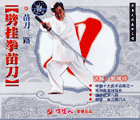
| Guo Ruixiang: "Pi Gua Quan and Miao Dao (Long Broadsword)" series of VCDs: | ||
|
Items GRX1-7 |
Guo Ruixiang, famous expert from
Cangzhou in Hebei Province, one of 10 Famous Wushu Masters in China,
inheritor of Pigua Quan and Miao Dao and son of famous Guo "the Swallow"
Changsheng |
|
|
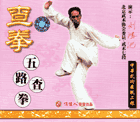
| Liu Hongchi: "Cha Quan" series of VCDs: | ||
|
Items CQ1-13 |
Cha Quan is a famous martial art
belonging to long fist category and practiced mainly by Chinese Moslems;
demonstrated by Liu Hongchi from Beijing, famous expert of the style and
member of Beijing Martial Arts Association: Note: Discount 10% off the price of the discs for the purchases of the whole set. |
|
|
Home ▪ About me ▪ Updates ▪ Taiji ▪ Bagua ▪ Xinyi-Xingyi ▪ Other Styles ▪ News ▪ Store ▪ Community ▪ Email
|
|
© Jarek
Szymanski 1999-2006. All rights reserved © ChinaFromInside.com 2006. All rights reserved |