|
Interview with Mr. Ma
Chuanxu, Liang Style Baguazhang expert from Beijing and president of the
Beijing Baguazhang Research Association |
|
by
Jarek Szymanski Photos
- Jarek Szymanski and from author’s collection; © J.Szymanski 2001 |
|
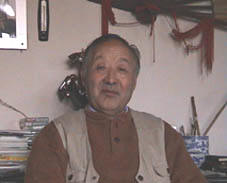
Mr.Ma Chuanxu, president of the
Beijing Baguazhang Research Association |
Mr.Ma Chuanxu was born in 1933
in Boye County in Hebei Province in the family with long martial arts
tradition. At the age of nine he was introduced to Shaolin Boxing by his
father. In 1951 his family moved to Beijing where he has been living since
then. In 1961 he started to study Baguazhang under Li Ziming, Liang Zhenpu’s
disciple and Dong Haichuan’s grand-disciple. He also learnt Xingyiquan,
Tanglangquan (Mantis Boxing), Taijiquan and Tongbeiquan from many renowned
old generation practitioners in Beijing. In 1978 Mr.Ma was employed by
Beijing Municipality Public Security Bureau as martial arts coach. In the
meantime he also taught as well as performed security services for the
Beijing Railway Bureau. He retired in 1993. Also since 1993 he has been the
president of Beijing Baguazhang Research Association. |
|
|
|
Mr.
Ma Chuanxu is a living legend among current practitioners of Baguazhang in
Beijing. Unlike many other teachers he gained his fame not by winning
routines competitions or appearing in martial arts magazines but because of
his fighting skills tested in many life-and-death fights with bandits during
years of service in Public Security Bureau. Only recently one of his
colleagues from PSB revealed some of Ma’s feats in one of Chinese martial
arts magazines - Ma Chuanxu defeated several art smugglers during a fight;
caught several drug dealers; “cleaned” train station in China’s Zhengzhou of
thieves and bandits (he alone caught more than 110 of them within a month).
He did it all without using any weapon. He is probably the only person
practicing internal martial arts who was employed as the main martial arts
coach by Beijing Municipality Public Security Bureau. Many of his students
now serve as bodyguards for high rank government officials in China. I have
heard about him since my arrival to China in 1990 - “Big Beard” Ma (Ma
Dahuzi) was considered to be the true inheritor of Li Ziming’s and Guo
Gumin’s Baguazhang - but never had a chance to meet him. The occasion arose
in November 2000 - so I called him and he invited me to his house and agreed
for interview. I found many of his explanations to be very clear and shedding
light on many issues - like Neigong, features of Neijia, Qi development -
that are often discussed but rarely understood by martial arts practitioners.
The interview below is basically full transcription of the conversation recorded
on the audio tape. |
|
Jarek Szymanski: Mr.Ma, you are very well known in martial arts
circles in Beijing but it is impossible to see you during any Bagua
competitions or meetings here... MR.MA CHUANXU: I was working for the Public Security Bureau
since 1978 and was teaching special forces. My official post was the General
Martial Arts Coach of Beijing Municipality Public Security Bureau. For this
reason I could not take part in many public activities, including Bagua
Meetings, nor have contacts with foreigners. JS: As a foreigner I wouldn’t be allowed to visit you
before? MR.MA: Yes, it was impossible before my retirement.
There is no problem now - I retired in 1993. JS: You are very famous for your fighting skills. It is not
very common nowadays that Neijia practitioners can effectively fight. When
did you start your martial arts practice? MR.MA: I started to learn martial arts when I was nine
years old. My family was practicing Shaolin boxing for many generations and
it was my first style to learn. In my village two styles were popular -
Shaolin and Da Hong Quan, but there were more people who practiced Shaolin. I
can’t say what branch it was as nobody really paid any attention to names at
that time. Our village was very big and there was a Buddhist temple there. My
grandfather learnt from a monk who lived in that temple. I learnt from my
father and what he taught was not routines but basics of Shaolin boxing,
mainly stretching and kicking. He was a very strict teacher and often hit me
with stick when I did not practice diligently. I had to perform front kicks
with straight leg so that the toes could touch my nose or the chin. When I
was in my thirties I was still able to pass below a wooden bench from its one
side to the other using Pu Bu very quickly. The bench was so low that my
chest had to touch the floor during the movement... There
were many exercises we had to practice, like Running on the Wall (Pao
Qiang)... JS: How did you practice this? MR.MA: First you lean a wooden board against the wall at
a small angle (between the board and the ground). Then you just run on
the board towards the wall and back. Your body has to be kept vertical to the
ground. Later the angle between the board and the ground increases and
finally the board is removed so that you just run directly up the wall. As
the result your toes can touch the shin. JS: You reached certain level in Shaolin Boxing. Why didn’t
you continue your studies but instead decided to learn Baguazhang? MR.MA: This is because my father (who was my Shaolin
Boxing teacher) told me that Baguazhang was extremely efficient martial art,
very demanding for legs, but different from Shaolin’s basics. He said that
what could be achieved by Shaolin Boxing practice could also be achieved
through Bagua practice; however there were skills that could be acquired only
through Bagua and not through Shaolin. My father also said that Baguazhang
was a higher level martial art than Shaolin Boxing; that it was the highest
level art among all styles. Xingyi emphasizes Crisp Power, Taiji - Sticky
Power, while Bagua - Clever Power (Xingyi Wei Cui, Taiji Wei Nian, Bagua
Wei Qiao). The best methods and techniques off all styles have been
synthesized into Baguazhang. JS: What does it mean that Bagua uses “Clever Power”? MR.MA: “Clever Power” in Bagua is expressed by its
techniques and strategy. Its like going somewhere - taking a longer way or
shorter. In Waijia you take a longer way, while Bagua practice is the
shortest way to fighting efficiency supported by internal skill. JS: Why did you decide to become Li Ziming’s student? MR.MA: It was by coincidence. When I learnt that a
colleague from the factory I worked in was Li Ziming’s student and studied
Bagua, I asked him to take me to the park they practiced. Since I already had
some skill and my waist and legs flexibility was very good, Mr.Li liked me
and when I asked to be accepted as his student he immediately agreed. JS: When did you start to learn from Li Ziming? MR.MA: In 1961. JS: When did you become Li Ziming’s disciple (indoor
student)? MR.MA: In 1976. This is because Li Ziming did not accept
any disciples when Guo Gumin (1887-1968; Li Ziming’s Shixiong - Older
Gongfu Brother) was alive, and then the Cultural Revolution (1966-1976)
came. Actually we were more like friends with Mr.Li. Li Ziming’s children
were calling me “Uncle”. I also learnt many techniques and practice methods
from Guo Gumin. |
|
JS: Is that true that Li Ziming learnt a lot from Guo Gumin? MR.MA: Yes, it’s true. They were Gongfu brothers (disciples
of the same master - Liang Zhenpu), but Guo Gumin was professional
martial art teacher. Li Ziming was younger than Guo and was busy running his
business - he was the owner of the largest (prior to 1949) soya sauce mill in
Beijing. Mr.Li was also engaged in underground work and covered many
Communist Party officials, including Wan Li and Liu Ren, who became
vice-mayors of Beijing after 1949. After liberation in 1949 Li Ziming was
holding important posts - was director of foodstuffs factory and beer
brewery - and before Cultural Revolution was promoted to controller position
in the First Light Industry Bureau in Beijing. JS: What happened during Cultural Revolution? MR.MA: Of course he came under attack, had to resign
from all posts and was persecuted. JS: Did you practice during Cultural Revolution? MR.MA: Only I continued Bagua study with Li Ziming
during that time. There had been about five, six of us who learnt Bagua from
Li Ziming in early 1960s, but they all gave up later and I was the only one
who kept on the Bagua study. JS: So you became Li Ziming’s disciple in 1976? MR.MA: Yes, in 1976 when Cultural Revolution was over.
There were about eight persons at that time who were accepted by Li Ziming as
indoor disciples, including Zhao Dayuan, Wang Tong, Sun Hongyan, Ma Ling,
Wang Shitong and Di Guoyong. Since at that time Li Ziming was already quite
old and did not practice much, getting more interested in traditional Chinese
painting and calligraphy, many of them learnt from me. JS: Many people say that you are quite conservative in
teaching and are very reluctant to pass some Bagua methods to students... MR.MA: I emphasize Bagua basics a lot. They are very
important and if the student does not practice them correctly, according to
my requirements, then it is like throwing all the things I teach away. It is
not that I’m conservative but the problem is that many students do not study
hard and never get satisfactory level of basic skills. Learning techniques
and routines is without any value if the basics are not good. JS: How can you develop basics? MR.MA: The are several methods. The most basic of them
is walking in a circle. It is divided into three so-called “basins” (San
Pan): Lower Basin, Medium Basin and Upper Basin. Yin-Yang concept is very
important as well - that’s why we often call Bagua “Yin-Yang Bagua”. Walking
counter-clockwise is Yang, while clockwise - Yin. There are many requirements
for walking practice: Hollow the Chest and Pulling Up the Back (Kong Xiong
Ba Bei), Collapse the Waist (Xia Ta Yao), Twist Hips and Keep
Knees Together (Niu Kua He Xi), Grasp the Ground Firmly with Toes (Zhua
Di Lao); Drop the Shoulders and Sink the Elbows (Chui Jian Chen Zhou),
Smooth Buttocks and Lift the Grain Path (anus) (Liu
Tun Ti Gang), Three Pressing (Head Presses, Tongue Presses and Hands
Press creating One Energy) and Three Round Principles (San Ding - Tou Ding
She Ding Shou Ding Hunyuan Yi Qi - San Yuan). Only if all these
requirements are strictly observed Internal Qi (Nei Qi) will appear
and Neigong (Internal Skill) will develop. Once Neigong develops, it’s like
electricity in hands. JS: What do you mean “electricity in hands”? MR.MA: The Intent becomes important. Intent drives Qi
and Qi drives Strength (Yi Dai Qi Qi Dai Li). One has to develop Qi of
Dantian to make use of it - and only then we can call it Neigong. JS: So what is “Neigong”? MR.MA: Neigong is Dantian. You have to attain high skill
in Intent (Yinian) practice and develop sufficient Internal Qi. It’s
like electricity. Dantian, three inches below belly button, once developed is
like a leather ball. Dantian becomes the place where all Internal Qi of your
body gathers, it’s like electric field. Then Qi - which is felt as a stream
of heat - flows from Hui Yin Point through lumbar vertebra, cervical
vertebra, Bai Hui Point (the hot feeling is extremely strong there), Mu Quan
Point, Tian Mu Point, Ren Tong Point. The most difficult place for Qi to pass
is where Ren and Du Vessels meet - you have to keep the mouth closed and the
tongue has to touch upper palate, breathing should be through nose (not like
in Long Fist Boxing where after some exercises practitioners have to use
mouth to catch the breath); then Qi flows down back to Dantian and completes
one full circle - Small Heavenly Circle (Xiao Zhou Tian). JS: Is there any specific feeling you have when the Small
Heavenly Circle opens? MR.MA: Of course. Once Small Heavenly Circle is opened a
lot of saliva appears in the mouth and when you practice you feel as
comfortable as if swimming. JS: Do you need to use any Intent (Yi) to lead Qi
flow? MR.MA: No, you should not think about Qi when you
practice. Small Heavenly Circle will open naturally, not intentionally, when
your Neigong reaches this level. However your practice has to be supervised
by a competent teacher. JS: Is it enough to open Small Heavenly Circle? MR.MA: No, you have to open the Large Heavenly Circle so
that Qi can reach your hands. This also takes time and you have to think
first - use Intent (Yi) - to drive Qi to the hands. Once Qi follows
your Intent, the next step is to be able to move Qi without any conscious
effort. The Qi will behave like mercury - once you strike with the hand it
immediately flows from out of Dantian, waist, and reaches the hand. The hand
will be felt by the opponent as very heavy. Only at this moment you can start
learning Bagua techniques and movements. |
|
JS: Does it mean that all Bagua movements are designed in
such a way that one must have Neigong first to be really able to use them? MR.MA: Exactly. Without Neigong all Bagua techniques are
good for nothing and there is no use to practice them. For this reason I’m
not willing to teach any techniques to students who do not have Internal
Skill - it’s waste of time for them and me. JS: I guess very few people can learn in this traditional
way? MR.MA: Yes, practitioners often feel that walking
exercise is very boring and give it up after some time. However once your
Neigong develops, once the Small Heavenly Circle opens, the practice becomes
very interesting. JS: Does Shaolin Boxing have similar methods? MR.MA: No, it does not. JS: As far as I know Taoists suggest that one should also
stop having sex, otherwise the Small and Large Heavenly Circles will never
open. Is that true for Bagua Neigong practice as well? MR.MA: Yes, this is very important condition. My teacher
told me that at the very beginning - if you want to develop true skill, you
must be like a monk, living in celibacy. There is a story about “Coal” Ma,
who was selling coal in Beijing’s Caishikou. When he started to study
Baguazhang from Dong Haichuan, he took his quilt and moved out to live in the
shop. He lived there for three years and did not return home even once during
that time. Your
body requires one week to recover after one sexual intercourse. i.e. come
back to the condition before the intercourse. One hundred days is required to
recover Original Qi (Yuan Qi) completely (i.e. recover to the condition
before one had any sex). About three years is required to open Small Heavenly
Circle. JS: What about married people? I’m afraid people who have
families will have difficulty with developing any Internal Skill then... MR.MA: There is not a big problem with practice in
Middle Basin (Zhong Pan), you can still get Internal Skill. However
once you decide to practice Lower Basin you have to stop any sexual activity. JS: What if one decides to practice in Lower Basin without
fulfilling that requirement? MR.MA: You will only hurt yourself. Lower Basin is a
very demanding practice for the body and it will not be able to endure it.
During Lower Basin practice you have to eat well and have good rest. It is
like having a bank account. If you draw 1 million dollars from it and then
transfer 1 million back it is OK. If you transfer 1 million and one dollar,
you will have little saving - surplus energy. However if you transfer only
990 thousand, you will be in dept - your body will not be able to recover
from the effort. In this way although your muscles may get stronger, your
internal strength, internal potential, will decrease. This phenomena can be
easily recognized by hearing one’s voice - weak voice, neither loud nor
clear, sometimes accompanied by coughing is the symptom of low energy level.
Lower Basin method is most suitable for young, unmarried people. Otherwise
you have to make the decision to become like a monk for three years... JS: We were talking about Small Heavenly Circle. What about
the Large Heavenly Circle (Da Zhou Tian)? MR.MA: Once the Small Circle is opened, the Large will
open naturally. There is a saying “Small Achievement comes in three years,
Big Achievement - in ten years” (Xiaocheng San Nian Dacheng Shi Nian).
One has to live in celibacy for at least six years to achieve true skill.
Once the skill comes out, you still have to limit the number of sexual
intercourses. Two, three times a week will ruin your skill completely. Once
every two, three months is not a big problem. JS: What do you mean by ruining the skill? MR.MA: Your legs and waist (lower back) will lose the
flexibility and strength. There are many martial arts practitioners who had
remarkable skill in youth but when older they could hardly walk. This was
caused by excessive sex. One of my teachers, Guo Gumin, was never married.
When I started Bagua practice in 1961, for six years I was practically living
in celibacy as well. At 5:00PM I was coming back home from work, ate dinner,
and immediately went to practice. I was coming back at 1:00AM, after 6-7
hours of practice. Everyday, without even one day of rest. JS: But in this way you did not sleep enough. You did not
have enough rest. MR.MA: Correct practice is better than sleep. What you
practice is Internal Skill, it nourishes your body. JS: You are almost 70 now. Do you still practice
everyday? MR.MA: I get up early in the morning and practice for
three hours, everyday. (Mr.Ma’s wife added that he does it everyday no
matter what the weather is, even on Chinese New Year, the most important
festival in China) JS: Back in the 1960s did you practice any other exercises
apart from walking in a circle? Some forms of sitting meditation or standing
pole (Zhan Zhuang)? MR.MA: Sitting or standing meditation are for Neigong
only. Walking practice is also called “Moving Pole” (Huo Zhuang/Xing
Zhuang) and has very important advantage - it develops both Waigong
(External Practice) and Neigong at the same time. When you walk in a circle,
you nourish your Internal Qi every minute, you build it stronger and
stronger. That’s why walking in a circle is so important and at the same time
so difficult to understand. JS: Did you learn and “Light Skill” (Qing Gong) as
well? MR.MA: Walking in a circle develops “Light Skill”. Once
you reach a certain level you are able to walk without touching the ground. JS: How is that possible? MR.MA: The idea is to use your Dantian, waist, to move.
I’m sitting here right now. If you want to attack me I can move fast forward
without using legs, but by straightening the waist. (Mr.Ma made a
demonstration - from a sitting position he was able to move fast very far
forward before he touched the floor with his legs). JS: It all sounds and looks very mysterious... MR.MA: It is not mysterious at all, it’s just a matter
of skill, of hard practice. JS: How did it happen that people learnt about you? MR.MA: I learnt not only from Li Ziming but also from
Han Lanyu (Wu Xing Chui expert, Bao Zhang’s disciple), Guo Gumin (Baguazhang
expert, Liang Zhenpu’s disciple), “Tong Bei” Li, Han Qichang (of Mei
Hua Zhuang). My teacher used to take me to all these teachers and usually
I had to fight with their disciples. This is how people started to know about
me... JS: I have heard that you also defeated one quite famous
foreign martial artist? MR.MA: There was one foreigner, whose Xingyi was very
good. He wanted to study with Li Ziming and become his disciple. Many of Li’s
students like Zhao Dayuan and Wang Tong were there. They all crossed hands
with the foreigner and lost. His Xingyi was very impressive - when he
demonstrated it, in the opening movement all his joints were cracking. His
External Skill was really good, but his Internal Skill was not. He did not
use his strength correctly - held it back in his own body, tensed his muscles
too much, had no roots. JS: You mean one has to be relaxed when practicing Bagua? |
|
MR.MA: In Bagua we say “walk like a monkey” - light and “clever”
(Qiao)... JS: “clever”? MR.MA: “Shrink, Be Soft like Cotton and Clever” (Suo
Xiao Mian Ruan Qiao) so that you can shrink your body, without using any
strength, relaxed, like a spring, that can be released at any time, but only
upon contact with the opponent, never before. Trying to use power on distance
is not effective. JS: Is this so-called “One-Inch-Power” (Cun Jin) that
you are talking about? MR.MA: Yes, in Neijia we strike using One-Inch-Power.
Hitting from a distance is not effective as it does not really hurt the
opponent. The worst what can happen are some bruises that can heal in few
days. When I strike my opponent I want him to spit with blood...This is the
reason we emphasize Neigong so much. When you have Neigong, if you want to
hurt the opponent, you can hurt him; if you want to push him into the air
like a leather ball, you can do it as well at will. |
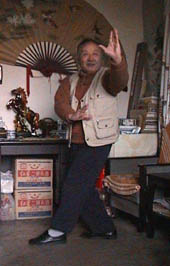
Ma Chuanxu demonstrating “Pushing
and Grinding Palm” (Tui Mo Zhang) - one of eight basic walking postures of
Liang Zhenpu’s Baguazhang |
|
|
|
JS: Have you ever practiced any hardening or strengthening
methods? MR.MA: No, I did not. These exercises develop external,
stiff power. What we want is the Internal Qi which drives all the movements.
It’s like mercury, once you strike it’s there, once you withdraw - it returns
as well. It’s flexible, alive. JS: Apart from hand techniques one must also master footwork
and be able to use legs when striking. MR.MA: Qi arrives and Strenght (Li) arrives. That
means we have to practice to achieve “harmony” (He). Hands, eyes, body
and footwork have to combine (He) into one. Once we strike they all
arrive at the same time, body becomes one, “coordinated power of the whole
body” (Zheng Jin) is used. We develop it through practicing walking
the circle, single techniques, routines. In Taijiquan there is a saying “When
the opponent does not move, I do not move either; once the opponent moves, I
move first” (Bi Bu Dong Wo Bu Dong; Bi Yi Dong Wo Xian Dong). One has
to achieve “harmony” of the whole body so that it moves as one to be able to
move like this. This is called true “harmony” (He). JS: It is easy to understand the first part of the saying :”When
the opponent does not move, I do not move either” but could you explain the
second part? MR.MA: “Once the opponent moves, I move first”. This
means once the opponent decides to move, there is a very short moment when he
prepares to attack. You should be able to notice this moment and strike when
it is not over yet. This requires very good Neigong and high skill - timing
and speed. JS: Some people say that Bagua is not as soft as Taijiquan,
its softness is of different quality. What do you think about it? Should one
be completely relaxed when walking in a circle? MR.MA: One should be relaxed (Song) but at the
same time look for “coordinated power of the whole body” (Zheng). One
should keep the “coordinated power of the whole body” (Zheng) but at
the same time relax (Song). It is very difficult to find balance
between these two states. One should also avoid excessive tension when
looking for “coordinated power of the whole body” (Zheng). Softness is
very important in fighting - when the opponent strikes hard you can only use
softness to overcome his hardness. We call it “To overcome Hardness with
Softness” (Yi Rou Ke Gang) or “To Overcome One Thousand Pounds with a
Clever Method” (Yi Qiao Po Qian Jin). You need softness to use these
methods. JS: What do you mean by softness? MR.MA: The body has to express the “coordinated power of
the whole body” (Zheng) all the time, be relaxed, move in spirals. |
|
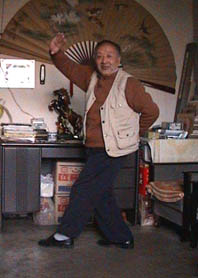
Ma Chuanxu in “Yin-Yang Fish”
Palm (Yin Yang Yu Zhang) developing spiraling power of the body |
JS: What do you mean by “move in spirals”? MR.MA: There should be axles all over the body. There
should be axles in shoulders, wrists, elbows, hips, knees. When you touch
this part of the body, there is an axle here; when you touch another part,
there’s an axle there too. The body should not be sloppy. Wherever you touch,
there’s an axle there and it moves in a spiraling way (luoxuan). The
power has to a be spiraling one and only then it can overcome opponent’s
power. JS: Can you use this “Spiraling Power” (Luo Xuan Jin)
in fighting? MR.MA: If the opponent touches any part of your body,
this part should express “Spiraling Power”. Guo Gumin was famous for his “Raising
Palm” (Tiao Zhang), also know as “Hand Thunder” (Zhang Shou Lei)
technique. It was based on Spiraling Power used to uproot the opponent upon
contact and then hit him which ended with opponent sent flying. Any technique
should have this spiraling component inside. JS: When you walk in a circle shall you also express this
spiraling power? |
|
|
|
MR.MA: Of course you
shall. You should walk like a heavy transporter which moves smoothly no
matter how bad the road is, whether its wheels get into a hole or meet a
stone. One should not over-emphasize grasping the ground with toes (Shi
Zhi Zhua Di) as this may result in stiff (dead - Si) power. JS: What about “Mud Wading Step” (Tang
Ni Bu)? MR.MA: There is a
saying “Walk as if rubbing the ground but you must not rub the ground” (Xing
Er Ca Xing Mo Yao Ca). The meaning is that feet should move close to the
ground, not too high. The second part of this saying - “you must not rub the
ground” - is most important. You should walk like a monkey, feet should be
placed on the ground very lightly. You must not rub the ground with the
soles, otherwise the power will be dispersed. JS: I have seen some Bagua practitioners
who, after they make a step with the front leg and before they put it on the
ground, “throw” the body forward so that the front foot can move more
forward. Is this a correct way of practicing “Mud Wading Step”? MR.MA: No, it is not
correct. You should never lose control over your gravity center, because the
power of the body will be dispersed. JS: Their explanation is that this way
of practice allows them to advance and cut the distance faster... MR.MA: You should use
the waist to drive your body forward, for advancing. Body should be like a (spinning)
top, with center of gravity well controlled. The center of gravity should be
always on the front leg. You have to “smooth the buttocks and Lift Anus”,
assume a posture similar to that when sitting on a chair, then the waist
drives your legs, center of gravity is on the front foot, and you can advance
very fast. (Mr.Ma demonstrated this way of walking) JS: You are known to be a very strict
teacher. Do you have many students who reached a satisfactory skill level? MR.MA: I can think of
two, they both work in the Beijing Municipality Public Security Bureau. One
of them, Chen Xiangxian, is the main martial arts coach there. He took that
post when I retired in 1993. JS: What do you think about the level
of Bagua practitioners in Beijing? MR.MA: The level of
current practitioners, teachers, is far below that of old generation masters.
People like Fan Fenglan, Guo Gumin, Gao Ziying had true gongfu, which can
hardly be said about current generation. This is in spite of the fact that
many of them publish books and are getting increasing popularity. JS: When did you became the head of
Bejing Baguazhang Research Association? MR.MA: In 1993 when my
teacher, Li Ziming passed away. I took over the position of the president of
the Association. JS: What Bagua branches belong to the
Association? MR.MA: All Bagua
branches practiced in Beijing area are represented in the Association. These
are Yin Fu’s, Cheng Tinghua’s, Liang Zhenpu’s, Fan Zhiyong’s and Song
Changrong’s branches. Song branch has very few practitioners. We have
meetings every month. During this year’s election I was again elected the
president of the Association and Gao Jiwu (late Gao Ziying’s son), Wen
Dasheng (Fan Fenglan’s disciple), Wang Shanzhi (Wang Fu’s son; Wang
Fu studied Yin style from Yin Fu’s son, Yin Yuzhang) - vice-presidents;
Jia Suosen is the secretary. JS: Did you study Taijiquan? MR.MA: Yes, I learnt
Shanxi Taijiquan from Li Ziming; I also learnt a bit from Gao Ziying and Bao
Zhang’s son, Han Lanyu. Once you master one martial art than it is very easy
to learn other styles. Learning hundreds of techniques / routines is useless.
“Once one is mastered all are understood” (Yi Tong Bai Tong). JS: Do you think Taiji and Xingyi
should build similar Internal Skill to Bagua? MR.MA: Yes, all these
styles should emphasize Neigong. JS: What about Shaolin? MR.MA: Late Liu
Wancang, practicing both hard styles and Taijiquan (Wu Jianquan’s branch;
he taught in Ditan Park) was very advanced in Neigong. He was very strong
and used to exercise with 40 kg heavy stone balls. Besides there were also
quite a few Shaolin practitioners (like the late Hu Laodao teaching in
Taoranting Part in Beijing) who reached high Neigong level. JS: Was their power like the mercury -
what you just mentioned talking about Bagua’s Neigong? MR.MA: No, their
Internal Skill was not that good. Although they reached relatively high level
of Neigong, it was still inferior to the one that correctly practiced Neijia
styles allow for. I do not think external styles can achieve the highest
levels. JS: Have you practiced any strength
building methods (like the one mentioned above - stone ball). MR.MA: No, I have never
practiced them. JS: What about long spear (Da Qiang)? MR.MA: Yes, I practiced
with long spear. It’s length is one Zhang and two Chi (about 4
meters). I learnt Bagua Long Spear exercises from Li Ziming. The goal is to
build the power and learn correct body method (Shenfa) - opening the
joints and “pulling out” the power (dynamically stretching the tendons). This
method has to be used to improve one’s skill. People who do not practice
martial arts have rather stiff joints which limit their range of movements.
By long spear practice one can open the joints, increase their flexibility
and hence improve agility of movements. |
||||
|
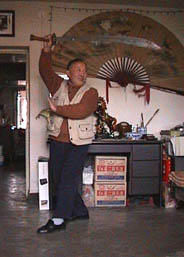
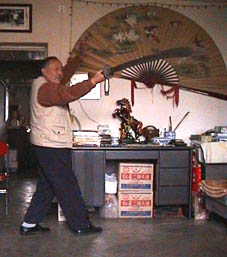
Ma Chuanxu practicing with
Bagua Broadsword |
||||
|
|
|
|
|
|
|
JS: What about other Bagua weapons? What is the goal of
practice with weapons in Bagua? MR.MA: Every weapon has its characteristics and is
practiced to achieve specific goal. Taking as example Bagua Broadsword - it
is used to exercise Twisting (Ning), Wrapping (Guo), Drilling (Zuan)
and Overturning (Fan). Twisting is for body method (Shenfa).
Bagua Broadsword is big - four Chi two Cun (about 1.2m) - and
the main principle for its practice is “you walk (move) but the broadsword
does not move” (Ren Zou Dao Bu Dong); “it is not the man who plays
with the broadsword but the broadsword that plays with the man” (Dao Shua
Ren Bu Shi Ren Shua Dao). My broadsword is long and big and always points
at the opponent so it is not easy for him to enter. Once he attacks I just
use “Overturn” (Fan) and cut his arm with the broadsword. JS: So do you practice Bagua broadsword techniques or
improve your Shenfa through broadsword practice? MR.MA: Both. Not only you can learn how to use the
broadsword, but what is more important - improve your Bagua skills,
especially the body movements. It is said “Man follows the broadsword,
broadsword moves with the man” (Ren Sui Dao Zou, Dao Sui Ren Xing). JS: Which weapon is the most important in Bagua? MR.MA: All are very important and none is really
important. The most important is Gongfu - the skill. Once you have the skill
you can use anything as a weapon. It has no use to learn lots of weapon
routines - once you have Gongfu than learning weapons is very easy. JS: What about the straight sword? MR.MA: Broadsword and straight sword methods are not
separated (Dao Jian Bu Fen) in spite of the fact that the sword has
different structure than the broadsword. JS: What are the features of Bagua spear? MR.MA: In Bagua we have Bagua Long Spear and Short
Spear. The latter is also called “Snake with Two Heads” (Shuang Tou She)
as it has spearheads on both ends. Its main feature is using long weapon on
short distance (Chang Qiang Duan Yong) and it differs from typical
spear methods of “Lan Na Zha”. In Bagua you redirect opponent’s spear
with one end of your weapon and strike him with the other end. Once you can
apply the principle of “using long weapon on short distance” than you can
effectively use a short stick even against a broadsword. This can be easily
seen in techniques of another typical Bagua weapon - Seven Star Stick (Qi
Xing Gan) - which is mainly used for point striking. While using
long weapon one has to be able to use so-called “flexible grasp” (Huo Ba)
which allows for changing the grasp of the weapon without loosing contact
with it. JS: Are there matched routines in Baguazhang? MR.MA: Yes, we have quite a few matched routines
practiced with partner. Probably the most famous and one of the most
treasured is “Four Matched Routines of Chopping Broadsword” (Si Tang Dui
Pi Dao); other are: “Matched Routine of Chopping Swords” (Dui Pi Jian),
“Matched Routine of Chopping Sticks” (Dui Pi Gan), as well as “Seventy
Two Seizes” (Qi’Shi’Er Na), “Seventy Two Linked Kicks” (Qi’Shi’Er
Jie Tui), “Eight Main Seizes” (Liu Ba Zong Na), “Seventy Two
Techniques” (Qi’Shi’Er Zhao) and others. JS: What are the features of Bagua free fighting? MR.MA: Bagua free fighting is different from other
styles. The most important feature is that both hands move towards the
opponent at the same time. In other styles when one hand moves towards the
opponent the other is drawn back. In Bagua it is important to strike fast and
for this reason both hands move towards the target simultaneously. Hands have
to move fast, footwork has to be fast as well, only then one can achieve what
is called “excellency” (Bagua Wei Qiao). There is a saying “change in
fighting is in front of you” (Bian Hua Zai Qian Tou) which means that
the change of technique in fighting is in fast hands method, not in the whole
body. JS: Each of Bagua branches uses different shape of palm... MR.MA: Yes, Cheng branch uses “Eagle Claw Power” (Ying
Zhao Li), Yin branch - “Piercing Energy” (Yi Qi Guan Tong), Liang
branch - “Palm like Rows of Tiles on the Roof” (Wa Long Zhang, because
the fingers are placed one on each other like tiles on a roof). Dong’s
disciples were taught in different ways according to the style they had
learnt prior to Bagua study; this is the reason they have developed their own
styles with distinctive characteristics. Their hand techniques and body
methods are different. However all of them should express the “Spiraling
Power” (Luo Xuan Jin). This concerns not only Neijia, but also Waijia
styles. JS: Do you teach your students in a different way depending
on their body structure? Do you teach tall people in a different way then
short ones? MR.MA: No, I teach them in the same way. Although it is
said that tall people have difficulties in going into low postures, the real
question is only whether they spent enough time on practice. It is not true
that Bagua suits shorter people better than taller ones - all of them have
their advantages, but have to practice hard to be able to make use of them. JS: How many students do you have? Is it difficult to become
your “indoor disciple” (Rumen Tudi)? MR.MA: I have about 60, 70 indoor disciples. They had to
learn from me for at least three years before I accepted them as disciples -
I have to test morality of my potential disciples. JS: What do you teach? MR.MA: What I teach to my students depends mainly on
their level. As I mentioned before there is no use to learn many techniques
and routines if you do not have good basics. The first three years of
practice are very important as this is the shortest time to get the basics of
Neigong - Small Heavenly Circle can be opened; however high skill
requires about ten years to achieve. By high skill I mean being able to move
and respond naturally, without assuming any postures or thinking about using
any techniques. To attain the highest levels you not only have to practice
diligently, but also have to be gifted. |
|
|
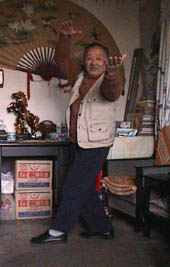
Ma Chuanxu in Fork Palm (Chazi
Zhang), also called Ball-Playing Palm (Rou Qiu Zhang) |
JS: What do you mean by “gifted”? MR.MA: One has to be intelligent, has to have strong
Power of Understanding (Wuxing). It is as important as practice. They
both are required if one wants to achieve the highest level of skill. One has
to be “good material” to become a true martial artists. JS: “Good material”? MR.MA: As I said before - one has to be clever, modest,
able to practice hard, with high moral standards. If somebody is very clever
but sly and cunning, such a person will never achieve much in martial arts.
One has to be steadfast in practice, honest, with interest in learning
martial arts, true “Martial Virtue” (Wu De). I do not teach clever
people who are not honest. |
|
|
|
|
JS: Do you teach children? MR.MA: Very few. In
China children study very hard at school and do not have much free time. JS: How old are your oldest students? MR.MA: The oldest ones
who start learning from me are in their 40s and 50s. Some of them practice
very well. Although their Wushu basics - understood as flexibility and
strength of waist and legs - cannot compare to that of young children, but
they make good progress in Neigong. This is absolutely sufficient to be able
to make good use of Bagua in fighting. JS: Do you think it is necessary to
learn Waijia before taking up Neijia? MR.MA: No matter
whether you learn Neijia or Waijia, you should first develop flexibility of
legs and waist. Once you have these basics you can make faster progress in
Neijia. Hence some kind of Waijia practice - Wushu basics - can be helpful
for your Neijia. Of course these basics can be also acquired through pure Neijia
practice, but it takes more time. Waijia can be considered a shortcut in
learning basics. There is however a difference - flexibility you get through
Bagua practice comes out naturally along the practice process and cannot be
lost, while in Waijia flexibility of legs comes from regular stretching -
once you give up stretching exercises the flexibility decreases very fast -
usually after three months without practice the flexibility is gone. In Bagua
once you can walk in the Lower Basin (Xia Pan) the flexibility of legs
greatly increases. JS: What is the characteristics of
Lower Basin (Xia Pan)? MR.MA: The definition
is that in Lower Basin hips and knees are on one level - like sitting on a
low chair. I used to practice walking in Lower Basin for one hour without
rest. My son has been practicing walking in Lower Basin for six years, for
two hours every day, so his Lower Basin skill is acceptable. Once the true
skill - Neigong - in Lower Basin is attained, the practitioner has the
feeling that his feet do not touch the ground while walking. We talked about
it already... JS: Mr.Ma, thank you very much for your time and generosity of sharing all this knowledge! |
||
|
native of Ji
County in Hebei Province; in 1921 started
to study Baguazhang from Liang Zhenpu and became his disciple; also learnt from Shang Yunxiang, Zhang
Zhankui and Ju Qingyuan; often exchanged skills with Guo Gumin, Li Shao’an
and Zeng Xingsan; in 1979 in order to protect Dong Haichuan’s
tomb he suggested to move it to Wan’an Public Cemetery from the old location;
on August 2nd and 3rd, 1980 a group of over 100
Beijing Baguazhang practitioners under his leadership moved Dong’s remains as
well as accompanying stone tablets to the new location in Wan’an Public
Cemetery. In 1981 the first single-style research
association in China - Beijing Baguazhang Research Association - was
established and Li Ziming was elected its first president, he held this title
until his death in 1993. Li Ziming was buried at Wan’an Public Cemetery near
Dong Haichuan’s tomb. (According to “Chinese Martial Arts Personages
Dictionary”, “The Dictionary of Contemporary Chinese Martial Arts
Practitioners” and article by Wang Tong in “Wuhun” 1993/4) |
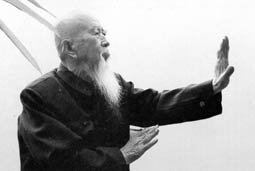
Li Ziming (1904-1993) was Ma
Chuanxu’s master and main teacher |
|
|
|
||
also known as
Guo Enpu or Guo Decang, was originally from Jizhou in Hebei Province. Born in
1887, he was interested in martial arts since childhood. At the age of 14 Guo
started to serve an apprenticeship at Liang Zhenpu’s secondhand clothes shop
and learn Baguazhang from Liang (Liang was one of Dong Haichuan’s
disciples). At the age of 20 Guo was accepted by Liang Zhenpu as indoor
disciple. Since that time martial arts became Guo’s profession. As early as
in 1920s Guo Gumin was already teaching Baguazhang in many places in Beijing. After Japan invited China in 1937 Guo was invited by
Japanese Embassy to teach martial arts. He rejected the invitation and had to
flee to Jinan in Shandong Province, where he taught martial arts to the army
of one of the local warlords, Han Fuju. |
Han first
tested Guo’s skill - he demanded that Guo would fight with his best spear
experts using wooden spears. Fifty were chosen out of three hundred and Guo
suggested that each of them should pierce him three times. As the result none
of them was able to pierce Guo and none managed to avoid Guo’s three stabs... After the war
Guo returned to Beijing and was teaching martial arts at Beijing’s Furen
University. After the liberation in 1949 Guo taught mainly in Beijing parks.
He passed away in 1968 at the age of 81, his body was cremated and the ashes
kept by his disciple, Su Shen until 1984, when two other Guo’s disciples, Liu
Jiemin and Wang Qichang, moved them to Beijing’s Wan’an Public Cemetery. His
tomb is located by the side of Dong Haichuan’s tomb. Guo was short
and thin; he never got married and devoted his whole life to martial arts. He
not only mastered Liang Zhenpu’s Baguazhang, but also learnt from and
exchanged skills with many other renowned martial arts experts of his time -
mainly “Big Spear” Liu (Liu Dekuan), but also Shi Jidong , Yin Fu, Liu
Fengchun (all were Dong Haichuan’s disciples), Han Fushun (Shi Jidong’s
disciple), Ma Gui (Yin Fu’s disciple), Yin Yuzhang (Yin Fu’s son), Zeng
Xingsan (Yin Fu’s disciple) and others. Guo Gumin was
not only accomplished martial artist, but could also speak English and was a
good painter. He wrote two books: “Complete Book of Bagua Boxing” (Bagua
Quanshu Jicheng) and “Collected Texts on Bagua Rotating Palm” (Bagua
Zhuanzhang Huilan). The first one contains names of Bagua techniques and
routines as well as practice methods, while the other - history and - for the
very first time - theory of Baguazhang. (According to the
article “Great Baguazhang master - Guo Gumin” by Wu Yue published in “Wuhun”
1998/1) |
|
|
|
||
|
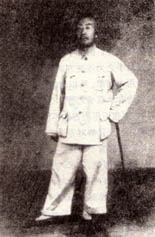
Guo Gumin (1887-1968) was one
of Ma Chuanxu’s teachers |
||